
A concrete structure can look perfectly sound from the outside and still leave an engineer with one important question:
What is the actual strength of the concrete inside it?
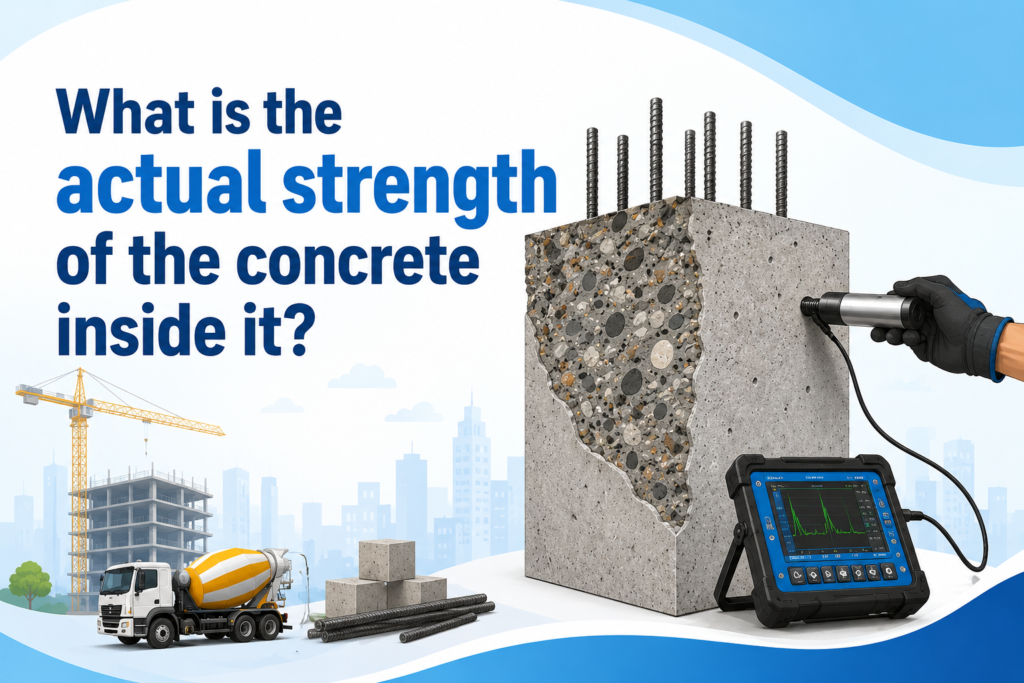
This question becomes important when cube-test records are unavailable, results are lower than expected, an older building is being assessed, or structural cracks in concrete have raised concerns about a member.
Visual inspection and non-destructive methods can provide useful clues. But when an engineer needs direct evidence of the concrete’s actual strength, the concrete core test method provides something other methods cannot: a physical sample taken from the hardened concrete itself.
So, why is core testing such a valuable part of structural assessment?
1. It Tests the Concrete Actually Present in the Structure
Laboratory cube tests provide the strength of test specimens prepared during construction. But the concrete in an existing structure may have experienced differences in compaction, curing, moisture, workmanship and placement conditions.
A core taken from a beam, column, slab or wall allows the engineer to examine the hardened concrete at the actual location.
This becomes especially useful when a structure develops cracks in concrete structures, even though earlier cube-test results appeared satisfactory. The engineer may need to determine whether the concrete currently present in the member has adequate strength.
A core cutting test in concrete can provide direct evidence that visual observations alone cannot.
2. It Provides Direct Strength Data Alongside NDT
A NDT test for concrete, such as the rebound hammer or ultrasonic pulse velocity (UPV) test, can help engineers investigate concrete without significantly damaging the structure.
These methods are useful for identifying variations, comparing different areas and locating sections that may need closer investigation. However, they provide indirect information about concrete properties.
Core testing takes the investigation further by physically testing a sample of hardened concrete under compression.
This means the two approaches do not necessarily compete.
A practical assessment may use NDT methods to identify potentially weak or unusual areas and then use core sampling when direct strength verification is required.
NDT can help an engineer identify where to investigate. Core testing can provide direct evidence of what is present.
3. A Core Can Reveal More Than a Strength Value
A concrete core is not simply a cylinder that goes into a testing machine.
Before the result is interpreted, the extracted sample can also be examined for features that may help explain the condition of the concrete.
Depending on the investigation, a core may reveal:
- Voids or poor compaction
- Aggregate distribution
- Visible cracks or discontinuities
- Weak zones
- Concrete uniformity
- Evidence of poor workmanship or bonding
This can be useful when investigating structural cracks. A crack does not automatically mean that the concrete has low compressive strength. Cracking can result from loading, shrinkage, thermal effects, restraint, deterioration or reinforcement-related issues.
Therefore, core testing should be treated as one part of a broader structural investigation, rather than as the only test required.
4. It Supports Important Engineering Decisions
The value of the concrete core test method is not simply the final strength value. The result can help an engineer make decisions about an existing structure.
For example, an older building may be undergoing renovation. The owner may want to modify a structural member, increase loads, remove walls or change the use of the building.
Before such changes, a structural engineer in Delhi may need reliable information about the existing concrete.
Core testing can be useful when:
- Cube-test results are doubtful or unavailable
- Actual in-situ strength needs verification
- An existing structure is being assessed
- Repair or rehabilitation is planned
- Construction quality is in question
- Structural distress requires further investigation
However, a core result should not be considered in isolation. Engineers may also need to review structural drawings, reinforcement details, crack patterns, NDT results, loading conditions and the history of the structure.
What Makes Core Testing Reliable?
The reliability of a core result depends on more than simply drilling a sample and crushing it.
The location, diameter, length-to-diameter ratio, extraction method and preparation can all affect the test result. Reinforcement should also be located before drilling so that important reinforcement is not unintentionally damaged.
This is why a core cutting test in concrete should be properly planned, carried out and interpreted by qualified professionals.
Different concrete strength testing methods have different purposes. NDT can help with screening and identifying variations, while core testing can provide direct strength evidence from the existing structural member.
The best assessment is often one that uses the right combination of testing methods for the engineering question being investigated.
Why the Concrete Core Test Method Remains Valuable
When engineers need to answer a straightforward but important question “What is the actual strength of this existing concrete?” core testing provides valuable direct evidence.
It can help verify in-situ strength, support structural assessments and provide information that complements visual inspection and NDT.
The test itself is only one part of the process. The real value comes from how the results are interpreted alongside the condition, design and intended use of the structure.
Need Reliable Concrete Strength Assessment?
If you are dealing with doubtful test results, structural cracks, an ageing building or a planned repair, choosing the right testing approach is important.
TESPRO Consultants provides structural audit, Non-Destructive Testing (NDT), structural stability assessment and structural engineering services to help evaluate the condition, strength and safety of existing structures.
Need to assess an existing concrete structure? Get in touch with Er. Kapil Chawla of TESPRO Consultants to discuss your project requirements.
Explore more: If planning to build your dream home?
Check out Eternal Foundations—a helpful guide to building a strong, safe home that lasts for generations.
📩 For a free e-book, email me at kapil.chawla@tesproconsultants.com