
Concrete strength testing tells you if a structure is safe to load. But results can go wrong for many reasons that have nothing to do with the actual concrete quality. Site engineers often see mismatched numbers between lab reports and real site conditions.Here we break down five factors that quietly affect concrete strength testing outcomes, so you get accurate data every time.
1. Concrete Strength Testing: Establishing Reliable Parameters for Accurate Results
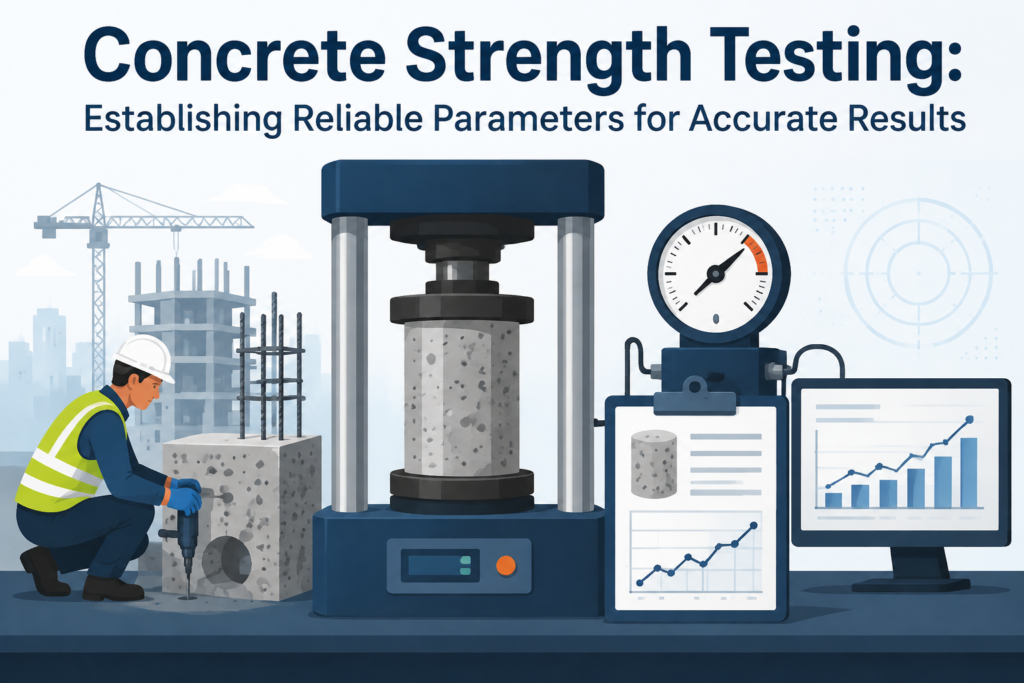
Before any test begins, some basic parameters decide how reliable the result will be.
- Sample size – Small or uneven samples give skewed readings.
- Test timing – Testing too early or too late changes the strength value.
- Load rate – Applying load too fast or too slow affects the reading.
- Reference standards – Not following IS codes leads to invalid comparisons.
Getting these basics right is the foundation of correct concrete strength testing. Skip this step, and every later result becomes questionable.
2. Mix Uniformity and Its Influence on Measured Concrete Strength
Even a good mix design can give bad results if the mix itself is not uniform.
- Water content – Extra water lowers strength readings.
- Aggregate grading – Uneven aggregate sizes cause weak spots.
- Mixing time – Under-mixing leaves pockets of weak concrete.
- Batch variation – Different batches from the same site can vary a lot.
This is where concrete strength testing methods matter, since different mix conditions may need different testing approaches to get a true picture.
3. Specimen Preparation Variables That Can Distort Strength Readings
How a specimen is prepared can make or break your test result, even if the concrete itself is fine.
- Mould quality – Damaged moulds give incorrect specimen shapes.
- Compaction level – Poor compaction creates air voids.
- Surface finish – Rough or uneven tops distort load distribution.
- Storage handling – Rough handling before testing can crack specimens.
For site teams relying on a concrete core test method, specimen prep errors are one of the most common reasons results don’t match expectations.
4. Curing Conditions and Their Impact on Strength Development
Curing is often the most ignored part of the process, yet it directly changes strength values.
- Curing temperature – Too hot or too cold slows strength gain.
- Curing duration – Short curing periods give lower strength.
- Moisture level – Dry curing conditions weaken the concrete.
- Curing method – Water curing versus membrane curing gives different results.
Poor curing is also a hidden cause behind later structural cracks in concrete, so this step deserves more attention on site.
5. Equipment Calibration and Testing Procedures as Sources of Result Variation
Even correct concrete and correct specimens can give wrong readings if the equipment or process is off.
| Equipment factor | Source of error |
| Machine calibration | Uncalibrated machines give inconsistent loads |
| Operator technique | Different operators apply load differently |
| Testing frequency | Rare calibration checks let errors build up |
| Data recording | Manual errors in reading or noting results |
This is also where the NDT test for concrete becomes useful, since non-destructive methods can cross-check results without damaging the structure.
Frequently Asked Questions
Q1. Which IS code governs concrete strength testing for cube specimens in India?
Cube testing procedure, curing duration, and acceptance criteria are governed by IS 516, read alongside IS 456 for acceptance limits.
Q2. When is the concrete core test method preferred over standard cube testing?
Core testing is used when in-site strength is in question — after low cube results, fire damage, or when checking an existing structure with no cube record.
Q3. What does an NDT test for concrete actually measure, and where does it fall short?
Rebound hammer and UPV tests estimate surface hardness or wave velocity as a proxy for strength; they don’t give direct compressive strength and need correlation with core data for reliable use.
Q4. Who should be consulted when concrete strength testing results show structural cracks in concrete or borderline values?
A structural engineer in Delhi should review the data and, where needed, carry out a structural audit of buildings in Delhi to assess load-bearing safety before any repair decision.
From Test Results to Structural Assessment: Making Concrete Strength Data Actionable
Once you have your test data, the real work is using it correctly.
| Action | Purpose |
| Result comparison | Compare results against design strength, not assumptions |
| Trend tracking | Track results across multiple pours to spot patterns |
| Risk flagging | Flag low results early instead of waiting for visible damage |
| Expert review | Get a qualified engineer to interpret borderline results |
Left unchecked, testing errors can hide early signs of cracks in concrete structures, which only get costlier to fix later.
If your site is facing unclear concrete strength testing results or you need an expert opinion on structural safety, Er. Kapil Chawla of TESPRO Consultants can help. With hands-on experience in structural audits and testing across Delhi/NCR and all over india, TESPRO Consultants offers practical, on-site guidance to keep your project safe and code-compliant.
Explore more: If planning to build your dream home?
Check out Eternal Foundations—a helpful guide to building a strong, safe home that lasts for generations.
📩 For a free e-book, email me at kapil.chawla@tesproconsultants.com