
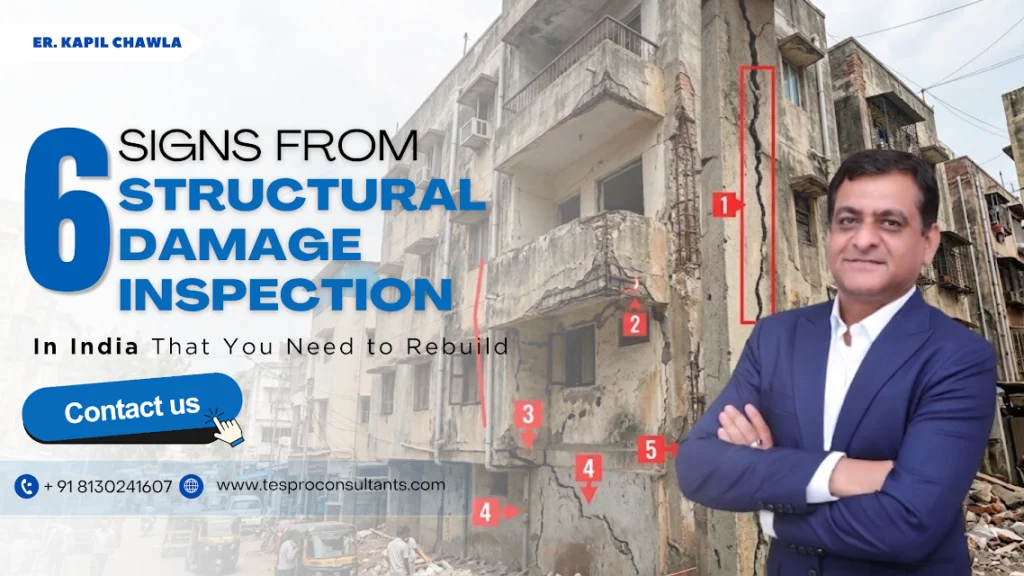
India has millions of aging buildings — residential societies, commercial complexes, and industrial structures that were built decades ago under older codes and standards. Many of these buildings look fine on the outside but carry serious structural risks inside. Structural damage inspection in India has become more critical than ever, especially in cities where buildings are overloaded, poorly maintained, or exposed to heavy monsoons, seismic activity, and rising groundwater. A proper building structural inspection does not just tell you what is wrong — it tells you whether repair is enough or whether you need to think bigger. Sometimes, the honest answer is: rebuild.
Engineering Evaluation Process During Inspection
A thorough building safety inspection OR structural damage inspection in India is not a visual walkthrough. It follows a defined engineering process that produces data, not guesses.
- Visual Survey: Inspectors document cracks, spalling, deflections, and surface deterioration across the entire structure.
- Material Testing: Core samples are drilled and tested for concrete compressive strength (IS 516). Rebound hammer tests and UPV (Ultrasonic Pulse Velocity) tests are standard.
- Rebar Assessment: Cover meter tests and half-cell potential tests measure corrosion levels in reinforcement steel embedded inside concrete.
- Load Analysis: Engineers review the current loading vs. the original design capacity. Many old buildings now carry loads they were never designed for.
- Foundation Check: Soil investigation, settlement readings, and subsurface profiling determine whether the base of the structure is still stable.
- Structural Audit Report: All findings are compiled into a building structure audit report with a clear technical opinion — repair, retrofit, or rebuild.
6 Signs That Indicate You Need to Rebuild
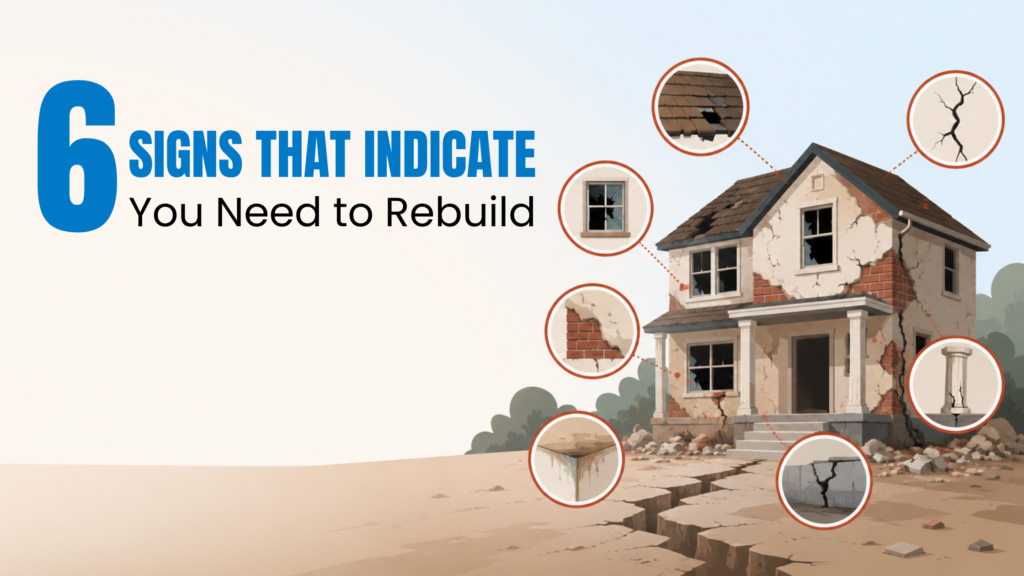
Not every crack needs a rebuild. But some signs go beyond what repair can fix. When a structural damage inspection in India reveals any of the following, structural consultants typically recommend full or partial reconstruction rather than patching.
Sign 1: Major Structural Cracks in Load-Bearing Elements
- Cracks wider than 3mm in columns, beams, or shear walls
- Diagonal cracks at beam-column junctions (sign of shear failure)
- Through-cracks that go from one face of a wall or column to the other
- Cracks that have reopened multiple times after previous repairs
- Any crack in a foundation member or plinth beam with visible displacement
Sign 2: Foundation Settlement or Uneven Sinking
- Visible slope or tilt in the building’s floors or external walls
- Doors and windows no longer align with frames
- Differential settlement — one side of the building sinking more than the other
- Settlement cracks starting from the base and travelling upward
- Confirmed by survey readings showing more than 25mm differential movement
Sign 3: Corrosion of Reinforcement (Rebars)
- Half-cell potential readings indicate active corrosion throughout the structure
- Rebar section loss of more than 20–25% confirmed by investigation
- Multiple columns or beams showing rust stains and delamination simultaneously
- Chloride-induced or carbonation-induced corrosion penetrated deep into the cover
- Widespread corrosion — not isolated — means the structural system is compromised
Sign 4: Severe Concrete Spalling and Deterioration
- Large chunks of concrete falling off columns, beams, or slabs
- Exposed rebars visible across multiple structural members
- Concrete compressive strength below 10 MPa on core tests (vs. M20 design)
- Honeycombing was detected deep inside structural members on the GPR scan
- Alkali-silica reaction (ASR) or sulphate attack, causing widespread disintegration
Sign 5: Excessive Structural Deformation
- Column or beam deflection beyond permissible limits under normal load
- Visible bowing of slabs (more than L/250 of span)
- Lateral drift in the building is detectable without instruments
- Floors or roofs visibly sagging or out of the horizontal plane
- Deformation that has progressed over time, even without additional loading
Sign 6: Repeated Repair Failures
- Same cracks or deterioration returning within 1–2 years of prior repairs
- Grouting, jacketing, or patching not holding under normal conditions
- The structural report shows residual load-carrying capacity below 50% of the original
- Cost of repair exceeds 60–70% of reconstruction cost (common benchmark in building inspection services)
- The repair scope keeps expanding with every new investigation
When Should You Decide to Rebuild?
Deciding to rebuild a building is a critical choice that affects safety, cost, and long-term durability. A professional structural damage inspection in India helps identify when repairs are no longer sufficient, and a complete rebuild is necessary. Consider the following indicators carefully:
- Residual structural capacity is below 50% of design requirements
- Two or more of the six signs above are present simultaneously
- Building age exceeds 40–50 years with no prior retrofitting
- The repair cost estimate crosses 60% of the fresh construction cost
- Seismic vulnerability assessment shows the building cannot survive a moderate earthquake
- Legal or municipal notice has been issued declaring the structure unsafe
- Occupant safety cannot be guaranteed during or after repair work
Talk to TESPRO Consultants Before You Decide
If your building is showing any of these warning signs, the first step is a proper structural damage inspection in India carried out by qualified structural engineers — not a general contractor or civil estimator.
A timely decision can prevent accidents, reduce long-term expenses, and maintain the value of your property.
For reliable building inspection services and expert guidance, consult Er. Kapil Chawla of TESPRO Consultants, a trusted authority among structural consultants in Delhi, offers detailed evaluations and professional recommendations to protect your property and ensure safety.
Explore more: If planning to build your dream home?
Check out Eternal Foundations—a helpful guide to building a strong, safe home that lasts for generations.📩 For a free e-book, email me at kapil.chawla@tesproconsultants.com