tespro consultants

Rebound Hammer Test

Structural Assessment Methodology for the Building Strength Assessment 

The building strength assessment and structural assessment shall be carried out to evaluate the existing structural condition, identify structural deficiencies, assess the residual load-carrying capacity, and recommend suitable retrofitting or strengthening measures, wherever required. The structural assessment shall also support the planning of suitable structural retrofitting measures. 1. Site Visit and Visual Inspection 2. Collection and Review of Available Information 3. Structural Testing Conduct suitable non-destructive and semi-destructive tests, as required, to evaluate the in-situ condition of structural members. The testing program may include non destructive testing for buildings as part of the structural assessment: The extent and location of testing shall be decided based on site conditions and engineering judgment. The testing results shall provide useful information regarding concrete quality, uniformity, strength, reinforcement condition, and possible internal defects. Test locations shall be selected after considering visible distress, structural importance, accessibility, and the existing condition of different structural members. 4. Evaluation of Structural Condition Assess the residual strength, load bearing capacity of slab, and serviceability of the structure based on applicable Indian Standards through a detailed structural assessment. The collected information shall be evaluated together to determine the overall condition of the building. Structural performance, durability concerns, visible damage, material condition, and potential safety issues shall be considered during the evaluation. 5. Identification of Structural Deficiencies The identified deficiencies shall be classified based on their location, severity, and potential impact on structural performance. Areas requiring immediate attention, detailed investigation, repair, or regular monitoring shall be highlighted in the final assessment. 6. Recommendations for Retrofitting and Strengthening Based on the assessment, recommend appropriate repair, retrofitting, or strengthening measures, which may include: Other suitable strengthening techniques as per applicable standards and site requirements. 7. Submission of Final Report A comprehensive report shall be submitted containing: The report shall be prepared in accordance with relevant Indian Standards and accepted engineering practices. The final report shall clearly present all important observations, findings, test interpretations, and recommendations. Supporting photographs and available test records shall be included to provide a clear understanding of the existing structural condition. For a reliable structural assessment and expert engineering solutions, consult TESPRO Consultants. Under the guidance of Er. Kapil Chawla, the team provides professional structural evaluation, testing, and retrofitting recommendations. Explore more: If planning to build your dream home?Check out Eternal Foundations—a helpful guide to building a strong, safe home that lasts for generations. 📩 For a free e-book, email me at kapil.chawla@tesproconsultants.com

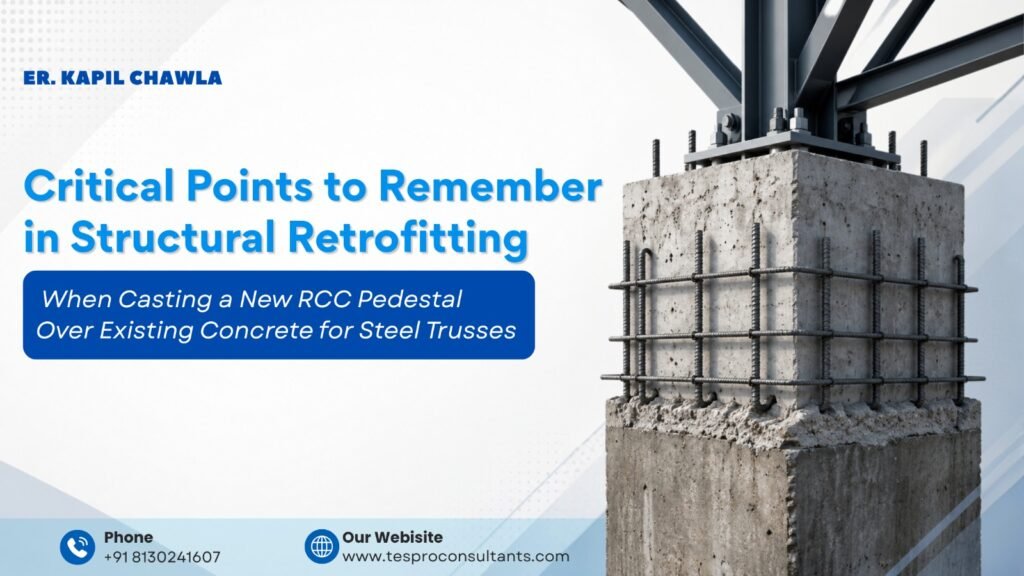
Critical Points to Remember in Structural Retrofitting When Casting a New RCC Pedestal Over Existing Concrete for Steel Trusses 

Retrofitting and strengthening existing structures is a common requirement in industrial buildings, warehouses, factories, and commercial projects where new steel trusses, equipment platforms, or roof extensions are proposed. One of the most critical aspects of such modifications is the construction of a new reinforced concrete (RCC) pedestal over an existing RCC member to safely transfer loads from the new steel structure. Such structural retrofitting projects should always follow the principles of the design of RCC structures. Improper execution can lead to poor load transfer, cracking, bond failure, anchor bolt distress, and long-term durability issues. Therefore, careful planning, structural audit services, structural assessment, quality control, and supervision are essential throughout the process. 1. Conduct a Detailed Structural Assessment Before Any Work Before commencing any demolition, drilling, or chipping activities, the existing RCC member must be thoroughly assessed by a structural engineer in Delhi or a structural consultant in Delhi. The assessment should verify: No structural retrofitting work should begin until the structural adequacy of the existing member has been confirmed. 2. Perform Non-Destructive Testing (NDT) on Existing RCC Members The strength and quality of the existing concrete should be verified through appropriate NDT test for concrete. Recommended tests include: Rebound Hammer Test The rebound hammer test is used for assessing the surface hardness and estimating the in-situ concrete quality. Ultrasonic Pulse Velocity (UPV) Test The ultrasonic pulse velocity test is used to evaluate concrete integrity, detect internal defects and cracks, and assess concrete uniformity. The test results help the structural engineer determine whether structural retrofitting or strengthening measures are required before pedestal construction. 3. Carry Out Controlled Concrete Chipping Concrete chipping should be performed carefully and only to the extent specified in the design drawings. Key precautions: Damage to existing reinforcement can significantly reduce the capacity of the original RCC member and may require additional repair measures during structural retrofitting. 4. Roughen the Existing Concrete Surface A smooth concrete surface does not provide adequate bond with newly placed concrete. The existing concrete surface should be mechanically roughened to expose sound aggregate and create a textured profile. Proper surface roughening improves mechanical interlocking and enhances composite action between old and new concrete. 5. Clean the Surface Thoroughly Before placing any bonding agent or concrete: A clean substrate is essential for achieving a durable bond between the old and new concrete. 6. Apply Nito Bond Epoxy Bonding Agent After surface preparation, an approved epoxy bonding agent such as Nito Bond should be applied on the roughened existing RCC surface. Benefits include: The bonding agent should be applied strictly in accordance with the manufacturer’s recommendations. 7. Provide Dowel Bars Between Old and New Concrete To ensure monolithic behaviour, the new pedestal must be mechanically connected to the existing RCC member using dowel bars or reinforcement connectors. Important considerations: Proper dowelling ensures the effective transfer of shear and tensile forces between the old and new concrete in structural retrofitting projects. 8. Use Non-Shrink Micro Concrete For pedestal construction, non-shrink micro concrete should be used wherever specified in the design. Advantages: The micro concrete should comply with project specifications and the manufacturer’s guidelines. 9. Maintain Proper Anchor Bolt Installation Anchor bolts are the critical connection between the RCC pedestal and the steel truss base plate. The following requirements must be strictly followed: Improper anchor installation can compromise the structural performance of the entire connection. 10. Use a Steel Template for Anchor Bolt Positioning A fabricated steel template should be used during casting to maintain: Using templates minimizes installation errors and facilitates the smooth erection of the steel truss. 11. Ensure Proper Concrete Placement, Compaction, and Curing The quality of concrete placement significantly affects pedestal performance. During concreting: Proper curing is essential for achieving the intended strength and durability. 12. Conduct Quality Control Tests on New Concrete All newly cast concrete should undergo standard quality control testing. Recommended tests include: Slump Test To verify the workability and consistency of fresh concrete. Compressive Strength Test Cube tests should be conducted at specified intervals to confirm compliance with the design of RCC structures and design strength requirements. Proof Load Testing of the Connection Where required, proof load testing should be carried out before commissioning to verify the performance of the pedestal-anchor-steel connection system. 13. Do Not Load the Connection Prematurely The newly constructed pedestal should not be subjected to steel erection loads or service loads until the concrete has attained the specified strength. Premature loading may result in: The structural engineer should certify readiness before loading. 14. Ensure Continuous Structural Supervision All inspection and quality control activities should be carried out under the supervision of a qualified structural engineer or structural consultant in Delhi. The structural engineer should verify: Professional supervision ensures that the structural retrofitting works comply with design intent and applicable standards. Conclusion Casting a new RCC pedestal over an existing concrete member for supporting a steel truss requires far more than simply pouring concrete around anchor bolts. Success depends on proper structural assessment, controlled demolition, effective bonding between old and new concrete, correct dowel detailing, accurate anchor bolt installation, rigorous testing, and continuous engineering supervision. For reliable structural audit services, including structural audit of buildings in Delhi, NDT test for concrete, rebound hammer test, ultrasonic pulse velocity test, and expert structural retrofitting, following these best practices ensures a safe, durable, and reliable load path between the new steel truss and the existing structure, thereby enhancing the overall performance and longevity of the facility. This article is ideal for showcasing your expertise in structural retrofitting, audits, strengthening works, and industrial steel structure modifications, which align well with your structural consultancy services. TESPRO Consultants has extensive experience in delivering safe and durable engineering solutions.  Explore more: If planning to build your dream home?Check out Eternal Foundations—a helpful guide to building a strong, safe home that lasts for generations. 📩 For a free e-book, email me at kapil.chawla@tesproconsultants.com 
Structural Testing Should Always Be Done in the Presence of a Structural Engineer

In the world of construction, one of the most overlooked yet crucial aspects is structural testing — the process that verifies whether the structure has actually been built to perform as designed. From cube testing and non destructive testing to pile load tests and core cutting, these are not just procedural checks. They are critical moments of validation that ensure the safety, strength, and serviceability of the built structure. Yet, on many sites, structural testing is often carried out casually — sometimes in the absence of the structural engineer who designed the structure. That’s where things can go wrong. Why Presence of the Structural Engineer Matters Common Tests That Should Be Witnessed by the Structural Engineer Each of these tests directly affects structural testing safety and integrity — and hence, should never be treated as a formality. A Small Step for Quality, A Big Leap for Safety In construction, shortcuts in structural testing can lead to long-term risks. The presence of a structural engineer during testing may seem like a small detail, but it often determines whether a structure stands strong for decades — or faces issues years later. Let’s move away from the mindset of “testing for paperwork” and adopt “testing for performance.” Every structural testing process is an opportunity to validate the structure’s safety — and the structural engineer is the right person to ensure that opportunity is not lost. If you are a client, contractor, or site supervisor — make it a standard practice:No structural testing should be done without the structural engineer’s knowledge and presence.Because true safety begins with true site supervision. Explore more: If planning to build your dream home?Check out Eternal Foundations—a helpful guide to building a strong, safe home that lasts for generations.📩 For a free e-book, email me at kapil.chawla@tesproconsultants.com

The Importance of Hiring a Structural Engineer in Non Destructive Testing (NDT) and Recommendations 

When it comes to the safety, durability, and functionality of a building, the role of a structural engineer goes far beyond just designing beams and columns. One of the most crucial yet often overlooked areas where their expertise is invaluable is in non destructive testing (NDT) and the recommendation process that follows. Non destructive testing techniques—such as ultrasonic testing, rebound hammer test, ground-penetrating radar, and ultrasonic pulse velocity—allow engineers to assess the health of existing structures without causing any damage. But raw test data alone is not enough. It takes the trained eye of structural engineering companies to interpret results, identify hidden risks, and chart a safe path forward using the right structural testing methods. Why Non Destructive Testing Needs a Structural Engineer? By combining knowledge of structural testing methods with real-world engineering expertise, they ensure that the data from non destructive testing translates into reliable solutions. Risk Mitigation and Future Safety Hiring a structural engineer during the NDT and recommendation stage brings long-term advantages: Structural engineering companies often highlight that using non destructive testing at early stages can save huge costs by preventing failures and extending building life cycles. Real-World Scenarios These scenarios show how non destructive testing and the types of NDT testing applied can vary depending on building usage, design, and age. Each structure requires a tailored approach. The Engineer’s Role: From Testing to Trust Non destructive testing is a diagnostic tool, but without an engineer, it’s like having a medical report without a doctor to explain it. So, structural engineers bridge this gap by: The rebound hammer test, for example, might indicate surface hardness, but engineers must connect it with deeper structural testing methods before declaring a structure safe. Conclusion Buildings are long-term assets, and their safety cannot be left to chance. Non destructive testing provides powerful insights, but it is the structural engineer’s expertise that turns data into actionable decisions. By choosing TESPRO Consultants, you get access to the right types of NDT testing and guidance from one of the most experienced structural engineering companies. With our expert team, owners and builders can ensure their structures remain safe, durable, and future-ready. Explore more: If planning to build your dream home?Check out Eternal Foundations—a helpful guide to building a strong, safe home that lasts for generations. 📩 For a free e-book, email me at  kapil.chawla@tesproconsultants.com