
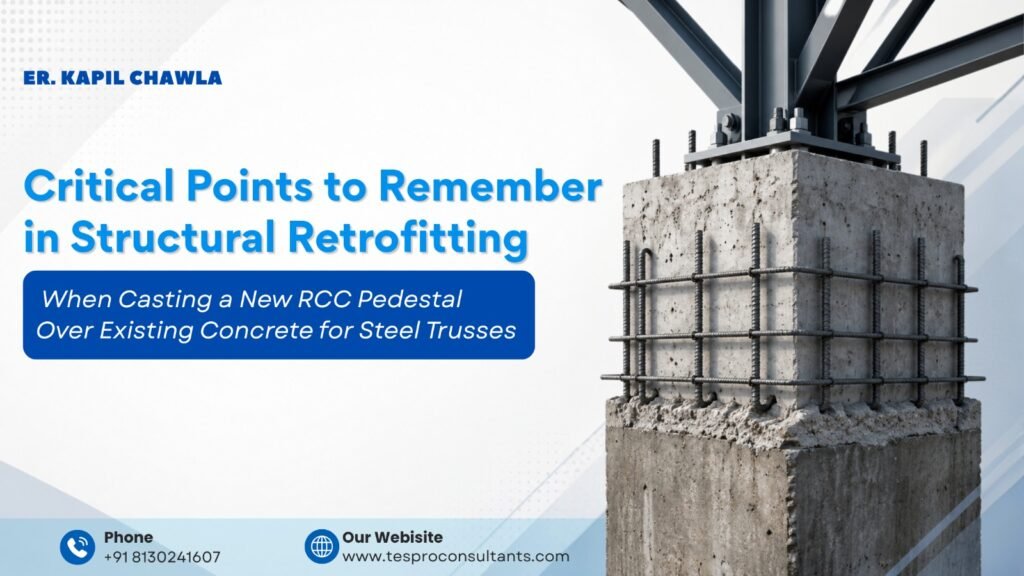
Retrofitting and strengthening existing structures is a common requirement in industrial buildings, warehouses, factories, and commercial projects where new steel trusses, equipment platforms, or roof extensions are proposed. One of the most critical aspects of such modifications is the construction of a new reinforced concrete (RCC) pedestal over an existing RCC member to safely transfer loads from the new steel structure. Such structural retrofitting projects should always follow the principles of the design of RCC structures.
Improper execution can lead to poor load transfer, cracking, bond failure, anchor bolt distress, and long-term durability issues. Therefore, careful planning, structural audit services, structural assessment, quality control, and supervision are essential throughout the process.
1. Conduct a Detailed Structural Assessment Before Any Work
Before commencing any demolition, drilling, or chipping activities, the existing RCC member must be thoroughly assessed by a structural engineer in Delhi or a structural consultant in Delhi.
The assessment should verify:
- Existing dimensions and reinforcement details.
- Concrete condition and signs of distress.
- Available load-carrying capacity.
- Suitability of the member for supporting additional loads from the new steel truss.
No structural retrofitting work should begin until the structural adequacy of the existing member has been confirmed.
2. Perform Non-Destructive Testing (NDT) on Existing RCC Members
The strength and quality of the existing concrete should be verified through appropriate NDT test for concrete.
Recommended tests include:
Rebound Hammer Test
The rebound hammer test is used for assessing the surface hardness and estimating the in-situ concrete quality.
Ultrasonic Pulse Velocity (UPV) Test
The ultrasonic pulse velocity test is used to evaluate concrete integrity, detect internal defects and cracks, and assess concrete uniformity.
The test results help the structural engineer determine whether structural retrofitting or strengthening measures are required before pedestal construction.
3. Carry Out Controlled Concrete Chipping
Concrete chipping should be performed carefully and only to the extent specified in the design drawings.
Key precautions:
- Avoid damaging existing reinforcement.
- Prevent excessive vibration that may weaken the parent structure.
- Remove only deteriorated or loose concrete.
- Expose reinforcement only where necessary.
Damage to existing reinforcement can significantly reduce the capacity of the original RCC member and may require additional repair measures during structural retrofitting.
4. Roughen the Existing Concrete Surface
A smooth concrete surface does not provide adequate bond with newly placed concrete.
The existing concrete surface should be mechanically roughened to expose sound aggregate and create a textured profile. Proper surface roughening improves mechanical interlocking and enhances composite action between old and new concrete.
5. Clean the Surface Thoroughly
Before placing any bonding agent or concrete:
- Remove all loose particles.
- Eliminate dust, latitude, grease, oil, and debris.
- Wash and clean the surface thoroughly.
A clean substrate is essential for achieving a durable bond between the old and new concrete.
6. Apply Nito Bond Epoxy Bonding Agent
After surface preparation, an approved epoxy bonding agent such as Nito Bond should be applied on the roughened existing RCC surface.
Benefits include:
- Improved bond strength.
- Enhanced load transfer.
- Reduced risk of interface separation.
- Better long-term durability.
The bonding agent should be applied strictly in accordance with the manufacturer’s recommendations.
7. Provide Dowel Bars Between Old and New Concrete
To ensure monolithic behaviour, the new pedestal must be mechanically connected to the existing RCC member using dowel bars or reinforcement connectors.
Important considerations:
- Dowel diameter and spacing should be as per the structural design.
- Adequate embedment length must be provided.
- Holes should be cleaned before grouting.
- Approved chemical anchoring systems should be used where specified.
Proper dowelling ensures the effective transfer of shear and tensile forces between the old and new concrete in structural retrofitting projects.
8. Use Non-Shrink Micro Concrete
For pedestal construction, non-shrink micro concrete should be used wherever specified in the design.
Advantages:
- Excellent flowability.
- High early and ultimate strength.
- Reduced shrinkage cracks.
- Superior bonding characteristics.
- Better load transfer between existing and new concrete.
The micro concrete should comply with project specifications and the manufacturer’s guidelines.
9. Maintain Proper Anchor Bolt Installation
Anchor bolts are the critical connection between the RCC pedestal and the steel truss base plate.
The following requirements must be strictly followed:
- Maintain adequate embedment length.
- Ensure sufficient edge distances.
- Verify bolt grade and diameter as per design.
- Protect threads during concreting.
Improper anchor installation can compromise the structural performance of the entire connection.
10. Use a Steel Template for Anchor Bolt Positioning
A fabricated steel template should be used during casting to maintain:
- Correct bolt spacing.
- Accurate bolt alignment.
- Proper verticality.
- Required projection above concrete.
Using templates minimizes installation errors and facilitates the smooth erection of the steel truss.
11. Ensure Proper Concrete Placement, Compaction, and Curing
The quality of concrete placement significantly affects pedestal performance.
During concreting:
- Place concrete in layers.
- Use mechanical vibrators for proper compaction.
- Avoid segregation and honeycombing.
- Maintain continuous curing as per specifications.
Proper curing is essential for achieving the intended strength and durability.
12. Conduct Quality Control Tests on New Concrete
All newly cast concrete should undergo standard quality control testing.
Recommended tests include:
Slump Test
To verify the workability and consistency of fresh concrete.
Compressive Strength Test
Cube tests should be conducted at specified intervals to confirm compliance with the design of RCC structures and design strength requirements.
Proof Load Testing of the Connection
Where required, proof load testing should be carried out before commissioning to verify the performance of the pedestal-anchor-steel connection system.
13. Do Not Load the Connection Prematurely
The newly constructed pedestal should not be subjected to steel erection loads or service loads until the concrete has attained the specified strength.
Premature loading may result in:
- Cracking.
- Bond failure.
- Anchor bolt displacement.
- Reduced long-term performance.
The structural engineer should certify readiness before loading.
14. Ensure Continuous Structural Supervision
All inspection and quality control activities should be carried out under the supervision of a qualified structural engineer or structural consultant in Delhi.
The structural engineer should verify:
- Surface preparation.
- Reinforcement installation.
- Dowel placement.
- Anchor bolt alignment.
- Concrete quality.
- Test reports.
- Final readiness for loading.
Professional supervision ensures that the structural retrofitting works comply with design intent and applicable standards.
Conclusion
Casting a new RCC pedestal over an existing concrete member for supporting a steel truss requires far more than simply pouring concrete around anchor bolts. Success depends on proper structural assessment, controlled demolition, effective bonding between old and new concrete, correct dowel detailing, accurate anchor bolt installation, rigorous testing, and continuous engineering supervision.
For reliable structural audit services, including structural audit of buildings in Delhi, NDT test for concrete, rebound hammer test, ultrasonic pulse velocity test, and expert structural retrofitting, following these best practices ensures a safe, durable, and reliable load path between the new steel truss and the existing structure, thereby enhancing the overall performance and longevity of the facility.
This article is ideal for showcasing your expertise in structural retrofitting, audits, strengthening works, and industrial steel structure modifications, which align well with your structural consultancy services. TESPRO Consultants has extensive experience in delivering safe and durable engineering solutions.
Explore more: If planning to build your dream home?
Check out Eternal Foundations—a helpful guide to building a strong, safe home that lasts for generations.
📩 For a free e-book, email me at kapil.chawla@tesproconsultants.com