

By a Structural Engineering Professional’s Perspective
For nearly a decade, engineering aspirants in India viewed Computer Science and IT as the safest route to career success. Meanwhile, civil engineering in India, despite being the foundation of nation-building and infrastructure development, often took a back seat.
However, 2026 is telling a different story.
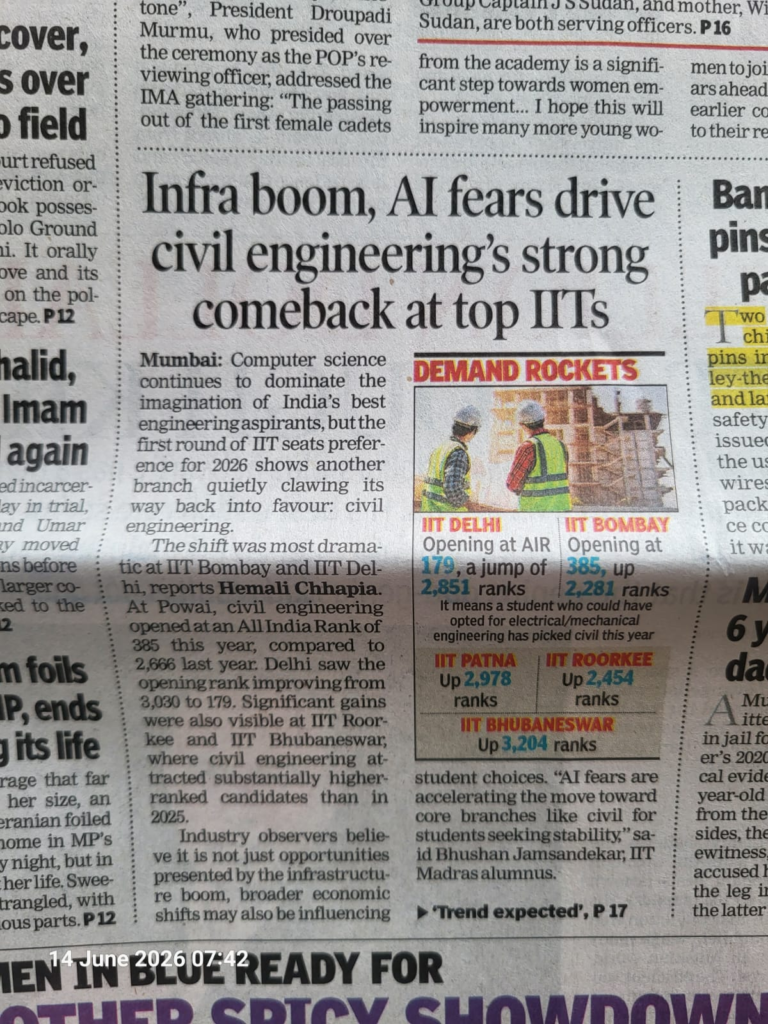
Recent IIT admission trends indicate a strong resurgence in Civil Engineering. Prestigious institutions like IIT Delhi, IIT Bombay, IIT Patna, IIT Roorkee and IIT Bhubaneshwar are attracting significantly higher-ranked students to the discipline than in previous years. Experts link this shift to two major factors:
- India’s unprecedented infrastructure expansion
- Growing concerns about long-term job stability in software-driven sectors due to AI
This changing perception signals a promising future for the industry.
What Is Driving This Revival?
1. India’s Infrastructure Boom
India is currently witnessing one of the largest infrastructure development cycles in its history. Massive investments are being directed toward:
- Expressways and highways
- Metro rail projects
- Airports and logistics hubs
- Industrial corridors
- Smart cities
- Affordable housing
- Water and wastewater infrastructure
- Renewable energy projects
The Union Budget 2026 increased capital expenditure to approximately ₹12.2 lakh crore, further reinforcing the government’s infrastructure-led growth strategy.
Unlike digital products that can be replicated instantly, physical infrastructure requires engineers, designers, project managers, and construction professionals. This continued investment is creating long-term opportunities across civil engineering companies, contractors, and infrastructure developers.
2. AI Is Influencing Career Choices
Artificial Intelligence is transforming industries worldwide. While AI is creating new opportunities, it is also generating uncertainty in several technology-focused professions.
Many students and parents now recognize that core engineering disciplines remain essential because infrastructure still needs to be:
- Planned
- Designed
- Inspected
- Constructed
- Maintained
A qualified civil structural engineer plays a crucial role in ensuring the safety and performance of buildings, bridges, industrial facilities, and public infrastructure.
As a result, careers offering practical impact, stability, and long-term value are gaining renewed attention.
3. Salaries Are Improving
One of the traditional concerns surrounding civil engineering in India has been compensation. Fortunately, that perception is gradually changing.
Large infrastructure projects, EPC contractors, metro corporations, and global consulting firms are actively seeking experienced professionals. Engineers with specialized skills are securing increasingly attractive salary packages.
High-demand specializations include:
- Structural Engineering
- BIM Management
- Construction Planning
- Project Controls
- Bridge Engineering
- Tunneling
- Industrial Structures
- Digital Construction
Professionals involved in advanced civil engineering design projects and large-scale infrastructure developments are witnessing significant salary growth.
Emerging Trends Shaping Civil Engineering
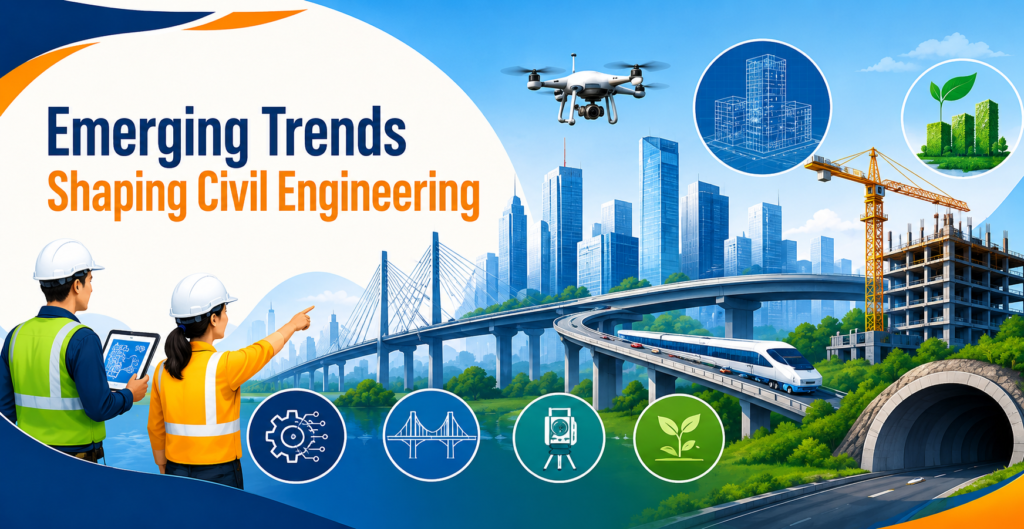
The modern civil engineer is no longer limited to site supervision and AutoCAD drawings.
Building Information Modeling (BIM)
BIM has become a critical requirement for major infrastructure projects. Engineers skilled in:
- Revit
- Tekla Structures
- Navisworks
- BIM Coordination
have a strong competitive advantage. Many civil engineering consultancy firms now prioritize BIM expertise when hiring.
Digital Twins
Infrastructure owners are increasingly adopting Digital Twin technology for:
- Asset monitoring
- Predictive maintenance
- Lifecycle management
- Performance tracking
This trend is creating new opportunities for engineers who can combine civil engineering expertise with data-driven decision-making.
Sustainable Construction
Sustainability is no longer optional. Key focus areas include:
- Green buildings
- Low-carbon concrete
- Recycled materials
- Net-zero infrastructure
These practices are rapidly becoming industry standards.
Modular and Prefabricated Construction
Modern construction methods are helping improve project delivery through:
- Faster construction timelines
- Better quality control
- Improved site safety
- Reduced material waste
Their adoption is expected to increase significantly in urban development projects.
AI-Powered Project Management
Interestingly, AI is not replacing engineers. Instead, AI tools for civil engineers are helping professionals improve productivity through:
- Project scheduling
- Risk prediction
- Quality monitoring
- Cost estimation
- Resource optimization
Engineers who embrace these technologies can gain a significant competitive advantage.
Opportunities for Structural Engineers
The outlook is particularly positive for professionals working in structural design and consultancy.
Growing demand exists across sectors such as:
- Industrial buildings
- Warehouses and logistics parks
- Data centers
- Renewable energy structures
- High-rise buildings
- Infrastructure projects
- Structural health monitoring
- Retrofitting and rehabilitation
Firms that integrate BIM, Tekla detailing, and digital collaboration into their services will be better positioned to capitalize on future growth opportunities.
Challenges Still Exist
Despite the positive outlook, several challenges remain:
- Skill gaps among graduates
- Low adoption of advanced technologies in smaller firms
- Project execution delays
- Rising material costs
- Shortage of BIM and structural specialists
Engineers who continuously upgrade their technical and digital skills will be best positioned to succeed.
The Road Ahead
The resurgence of civil engineering in India is more than an admission trend—it reflects broader economic realities.
As India continues investing in:
- Highways
- Metro systems
- Airports
- Smart cities
- Industrial corridors
- Sustainable infrastructure
The demand for skilled professionals and civil engineers will continue to grow.
At the same time, technologies such as BIM, Digital Twins, sustainable construction practices, and AI tools for civil engineers are transforming the profession into a technology-driven discipline.
Civil Engineering is no longer just about concrete and steel. It is about creating resilient, smart, and sustainable infrastructure for the future.
For engineers, consultants, and graduates, the message is clear: the next decade belongs to those who combine strong engineering fundamentals with digital expertise. As infrastructure investment accelerates, civil engineering in India is emerging as one of the country’s most promising and future-ready professions.
Explore more: If planning to build your dream home?
Check out Eternal Foundations—a helpful guide to building a strong, safe home that lasts for generations.
📩 For a free e-book, email me at kapil.chawla@tesproconsultants.com