

Whenever a building is inspected, two people can walk through the same site and come away with completely different conclusions. One may think, “The building looks fine,” while the other may quietly identify signs of structural distress that could become serious in the future. This difference becomes most apparent during a site visit. As a structural engineer with practical site experience, I have often noticed how differently a layman and an experienced engineer interpret the same observations. Let us understand this contrast.
What a Layman Usually Notices
For most people, a building is judged by what is visible on the surface. Typical observations include the following:
- Cracks on the walls
- Damp patches
- Peeling paint
- Uneven flooring
- Rust stains
- Exposed reinforcement
- A building that “looks old”
These are valid concerns, and in many cases they are the first warning signs that something may require attention. However, a layman generally focuses on appearance, not on the underlying structural behavior. A professional structural assessment helps identify the actual condition beyond visible signs.
What an Experienced Structural Engineer Notices
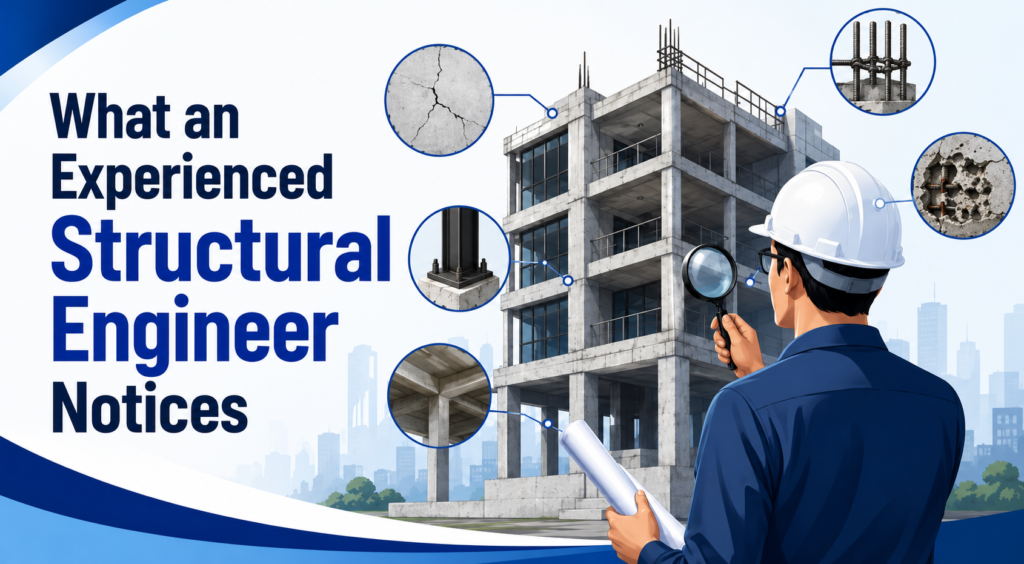
A structural engineer does not stop at the symptom. The real question is:
Why has this happened?
During a site visit, an engineer is constantly analyzing:
1. Crack Pattern and Orientation
A crack is never “just a crack.”
- Is it vertical, horizontal, diagonal, or stepped?
- Is it active or dormant?
- Is it caused by shrinkage, thermal movement, settlement, or structural distress?
For example, a diagonal crack near a beam-column junction may indicate a very different issue than a hairline plaster crack.
2. Foundation Behaviour
A layman may notice that a floor is uneven. An engineer asks:
- Has the building settled?
- Is the settlement uniform or differential?
- Are nearby excavations affecting the foundation?
- Is there any soil-related movement?
These questions help determine whether the issue is cosmetic or structural. In many cases, a detailed structural assessment of existing buildings is recommended.
3. Corrosion and Durability
Rust stains are often ignored as a maintenance problem. An engineer evaluates:
- The extent of reinforcement corrosion
- Cover the concrete condition
- Carbonation or chloride ingress
- Potential loss of steel cross-section
What appears to be a small rust patch may actually indicate a long-term durability concern.
4. Structural Modifications
One of the most critical observations during site visits is unauthorized alteration.
A layman may appreciate an open space created by removing a wall. An engineer immediately checks:
- Was the wall load-bearing?
- Has the load path changed?
- Are beams or slabs now overstressed?
- Is additional strengthening required?
Many structural problems begin after renovations that seem harmless.
5. Overall Structural System
An experienced structural engineer mentally reads the building like a framework:
- How are loads transferred from slab to beam, beam to column, and column to foundation?
- Are there signs of excessive deflection?
- Are beam-column joints performing properly?
- Is the structure behaving as intended?
This holistic understanding is what separates professional assessment from casual observation and supports a comprehensive structural health assessment.
A Real-World Example
Imagine a residential building with a crack running diagonally from a window corner.
Layman’s View
“Probably because of poor plaster or paint.”
Engineer’s View
- Measure crack width
- Check whether it extends through the wall thickness
- Inspect adjacent beams and columns
- Look for settlement signs
- Compare with cracks on other floors
- Determine whether monitoring or immediate repair is required through structural damage inspection in India.
The difference is not in what is seen, but in what is inferred.
Why Experience Matters
Textbook knowledge is important, but site experience teaches engineers to recognize subtle warning signs:
- Slight beam sagging
- Misaligned door frames
- Repeated crack repairs
- Hollow-sounding concrete
- Water leakage patterns
- Localized spalling
These small clues often reveal the actual condition of the structure.
The Biggest Misconception
Many people believe that if a building is standing, it is safe.
In reality, structures usually provide warning signs long before failure occurs. The challenge is that these signs may be subtle and easily overlooked by an untrained eye.
An experienced structural engineer is trained to
- Identify the cause
- Assess the risk
- Recommend the correct intervention
- Prioritize the safety of building
Conclusion
A layman sees symptoms. An experienced structural engineer sees behavior.
A layman asks, “What is visible?” An engineer asks, “What is happening inside the structure?”
That is the true value of a professional site visit. It is not merely an inspection of cracks, dampness, or old construction—it is an evaluation of the building’s health, safety of building, and future performance.
In structural engineering, every crack tells a story. The difference lies in who can read it correctly.
Contact Er. Kapil Chawla of TESPRO Consultants today for expert guidance and reliable structural solutions.