
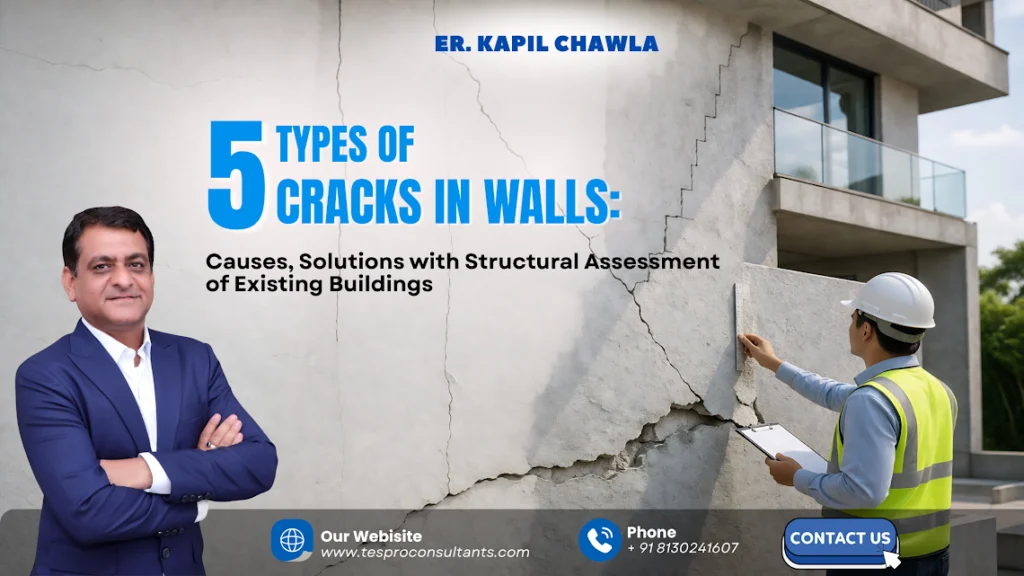
Cracks in walls are common in both new and old buildings, but they should never be ignored. Some cracks are minor and only affect appearance, but others may indicate deeper structural problems. That is why understanding the causes of cracks in walls and taking timely action is important. In engineering terms, cracks can develop due to stress, material behaviour, or poor construction practices. A proper building structural inspection helps identify whether the issue is surface-level or related to cracks in concrete structures. If ignored, these cracks may affect safety and long-term durability. Therefore, proper evaluation and structural assessment of existing buildings become necessary to ensure stability and performance.
Why Do Cracks Appear in Walls?
- Soil movement: When the soil under a building settles unevenly, it creates pressure on the foundation, and because of that, cracks start appearing in the walls.
- Thermal changes: When temperature varies, materials expand with heat and contract with cold, but if this movement is restricted, it can cause cracks in walls.
- Poor construction: When low-quality materials are used or curing is not done properly, the structure becomes weak, so cracks can develop early.
- Load issues: When there is too much load, or the load is not balanced properly, it creates stress in the structure, which leads to cracks in walls and other elements.
- Moisture impact: When water seeps into walls, it weakens the material and causes it to expand, leading to cracks in plaster and concrete surfaces.
- Design gaps: When proper joints or detailing are missing in design, stress builds at certain points, and because of that, visible cracks develop later.
These are the most common reason for cracks in walls, and each requires a different solution approach.
5 Types of Cracks in Walls You Should Know
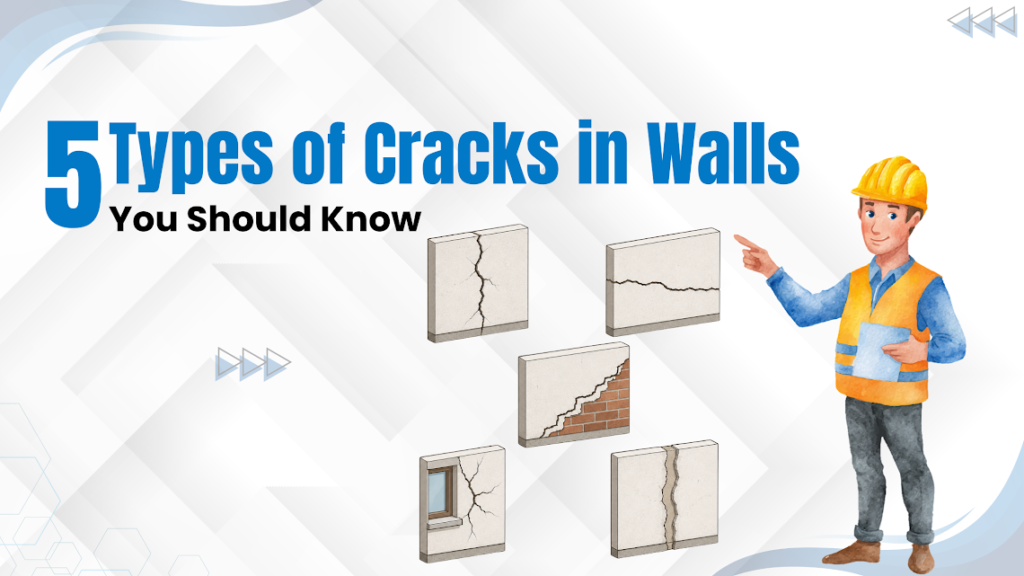
Cracks vary by pattern and cause, so identifying the type helps engineers decide the repair method and structural risk level accurately.
1. Vertical Cracks in Walls
- Mostly due to shrinkage or minor settlement
- Common in plaster and masonry joints
- Usually non-structural if thin
- Can be repaired with simple filling methods
- Needs monitoring if the width increases
2. Horizontal Cracks in Walls
- Often caused by soil pressure or structural stress
- Found in load-bearing walls or basement walls
- Indicates possible structural weakness
- Requires immediate building structural inspection
- May need reinforcement or rebuilding
3. Diagonal Cracks in Walls
- Caused by the differential settlement of the foundation
- Appear at the corners of doors and windows
- Can affect load distribution in the structure
- Needs expert evaluation
- Often linked to serious structural movement
4. Shrinkage Cracks in Concrete
- Develop during the drying of concrete
- Common in slabs and beams
- Usually fine and uniform
- Controlled by proper curing methods
- Not harmful unless excessive
5. Plaster Cracks vs Structural Cracks
- Plaster cracks are surface-level and cosmetic
- Structural cracks go deeper into the elements
- Structural cracks affect strength and safety
- Requires testing and professional inspection
- Important to differentiate during analysis
Understanding these types helps engineers decide whether cracks are harmless or part of larger cracks in concrete structures.
When Should You Be Concerned About Wall Cracks?
- Wide cracks: More than 3 mm width
- Growing cracks: Increasing over time
- Pattern change: New directions forming
- Water leakage: Dampness along cracks
- Door jam: Doors/windows not closing properly
- Multiple cracks: Appearing across the structure
- Structural lines: Cracks in beams or columns
These signs indicate that the issue may not be superficial. In such cases, professional inspection, like structural assessment of existing buildings, is required, and sometimes a structural stability certificate is needed to confirm building safety.
Role of Structural Assessment of Existing Buildings
- Visual check: Initial site inspection
- Crack mapping: Identifying patterns and spread
- Load analysis: Checking structural capacity
- Material testing: Strength and durability testing
- Foundation study: Soil and settlement analysis
- Repair planning: Suggesting suitable solutions
- Safety report: Issuing structural stability certificate
A proper structural assessment of existing buildings helps in identifying root causes, not just symptoms. It ensures that repairs are effective and long-lasting. Without assessment, repairs may only hide the problem instead of solving it.
For accurate inspection and reliable solutions, it is important to consult experienced professionals like Er. Kapil Chawla from TESPRO Consultants, who specialize in structural evaluation, safety analysis, and practical repair strategies.
Explore more: If planning to build your dream home?
Check out Eternal Foundations—a helpful guide to building a strong, safe home that lasts for generations.📩 For a free e-book, email me at kapil.chawla@tesproconsultants.com