

When planning a house, one common question is how much load a slab can safely carry. The load bearing capacity of slab is a key factor in structural safety because it decides how much weight your roof or floor can handle without damage. In residential projects, this depends on the types of slab design, material strength, and proper calculations. Many people ignore this and overload slabs with water tanks or heavy items, which can lead to cracks or failure. So, understanding slab strength is not just technical; it is practical for daily safety. Whether you are working on slab design for houses or selecting from different slab types, knowing the basics helps in making better decisions.
What is the Load Bearing Capacity of Slab?
- Simple Meaning: It is the maximum load a slab can safely carry without cracking, bending, or failing under normal working conditions in buildings.
- Dead Load: This includes the self-weight of slab, beams, flooring, plaster, and all fixed structural components permanently attached to the slab.
- Live Load: This refers to moving or temporary loads like people, furniture, appliances, and daily usage items that change with time and occupancy.
- Safety Factor: A safety margin is added during design to handle unexpected loads, material variation, and long-term usage conditions without structural risk.
- Load Types: Slabs are designed for both uniformly distributed loads and point loads, ensuring stability even when heavy weights are placed at specific locations.
5 Facts About the Load Bearing Capacity of Slab
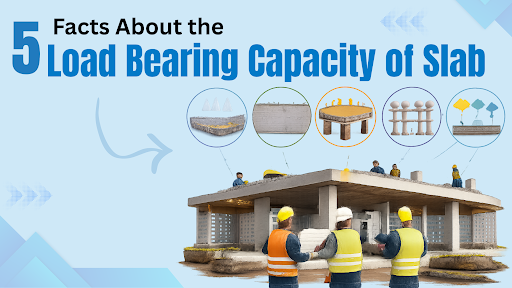
These facts help understand how slab strength works in real residential construction projects.
Fact 1: Slab Thickness Directly Affects Load Capacity
- Thicker slabs carry more load
- Standard thickness is 100mm–150mm
- Thin slabs may crack under heavy load
- Thickness depends on span and design
Fact 2: Grade of Concrete and Steel Matters
- Higher – grade concrete gives better strength
- Common grades are M20 and M25
- Steel bars (Fe415, Fe500) improve load resistance
- Poor material reduces slab life
Fact 3: Design Load vs Actual Load is Different
- Design load includes a safety margin
- Actual load may increase over time
- Overloading reduces safety
- Proper calculation is always required
Fact 4: Load Distribution is Not Always Uniform
- Loads are not always equally spread
- Heavy items create point loads
- Water tanks increase stress in one area
- Uneven load causes cracks
Fact 5: Structural Design Codes Define Safe Limits
- IS codes guide safe design
- Standard values used in calculations
- Engineers follow code-based design
- Helps avoid structural failure
Standard Load Capacity of Residential Slabs
- Typical live load is 2–3 kN/m²
- Dead load includes slab weight and finishes
- Total load is a combination of both
- Load depends on slab construction methods
- One-way and two-way slabs have different capacities
- A larger span reduces load capacity
- Safe limits are defined during slab design for houses
Factors Affecting Load Bearing Capacity of Slab
- Span Length: Longer span reduces load capacity
- Slab Type: One-way and two-way slabs behave differently
- Material Quality: Good concrete and steel increase strength
- Reinforcement Placement: Correct bar position is critical
- Construction Method: Poor work reduces actual capacity
- Curing Process: Proper curing improves durability
- Load Type: Uniform load is safer than a point load
- Structural Design: Depends on the types of slab design used
The load bearing capacity of slab is not a fixed number. It depends on design, materials, and execution. Whether you are planning a new house or modifying an existing one, understanding the types of slab in civil engineering and safe load limits is very important. Ignoring these basics can lead to serious structural issues.
For expert guidance and accurate slab design for houses, consult Er. Kapil Chawla of TESPRO Consultants. With strong engineering knowledge and practical experience, TESPRO ensures safe, reliable, and well-designed residential structures.
Explore more: If planning to build your dream home?
Check out Eternal Foundations—a helpful guide to building a strong, safe home that lasts for generations. 📩 For a free e-book, email me at kapil.chawla@tesproconsultants.com