
A building can look completely normal during a routine walk-through. Yet, inside the concrete, changes may already be affecting its performance.
An aging building or recurring dampness can hide problems that photographs cannot explain. This is where non-destructive testing services give engineers measurable evidence instead of relying only on appearance.
The Surface Can Tell a Story- But Not the Whole One
Visible cracks are only one part of structural diagnosis. Engineers need to understand what is happening beneath the surface and whether a visible symptom points to a deeper issue.
Non-destructive testing can help investigate:
- Internal voids, honeycombing, and discontinuities
- Variations in concrete quality
- Possible reinforcement corrosion
- Concrete cover and reinforcement location
- Carbonation-related deterioration
Every test measures something different, so one reading should not be treated as a complete structural verdict.
Non-Destructive Testing Services: Reading What Concrete Cannot Say
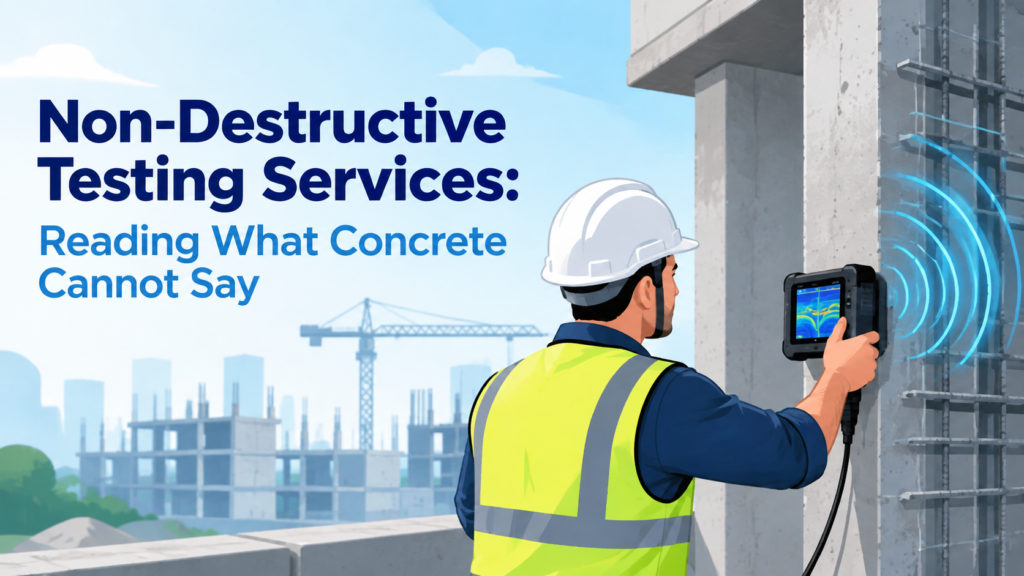
Consider a column that looks sound but produces noticeably different readings from neighbouring columns. That difference deserves investigation.
Rebound hammer testing can compare surface hardness. UPV testing can provide information about concrete uniformity and possible internal discontinuities. Reinforcement detection can locate bars and estimate cover, while corrosion-related tests can investigate deterioration around embedded steel.
Used together, non-destructive testing services can create a clearer picture of an existing member than visual inspection alone.
Why NDT Test for Concrete Is Not a One-Test Job
An NDT test for concrete should be selected according to the engineering question.
- Rebound Hammer: Helps compare surface hardness and identify unusual areas.
- Ultrasonic Pulse Velocity: Helps investigate concrete uniformity, internal cracks, voids, and poor-quality zones.
- Rebar Detection: Identifies reinforcement position and concrete cover before repair or structural modification.
- Carbonation Testing: Indicates carbonation depth, which can affect the protective environment around reinforcement.
- Corrosion Assessment: Helps investigate possible deterioration of embedded reinforcement.
The Smart Part: Connecting the Readings
This is where types of NDT testing become an engineering exercise rather than a checklist.
Suppose a beam has damp patches and surface cracks. A surface hardness test may show acceptable readings, while another investigation reveals unusual internal behaviour. If reinforcement cover is also low and carbonation has progressed, the engineer has several connected clues.
Non-destructive testing services help engineers identify patterns across structural elements and locations. A technically useful investigation therefore connects test results with drawings, site conditions, loading history and visible distress.
What Structural Damage Inspection in India Should Ask
For structural damage inspection in India, water ingress, alterations, additional loads and previous repairs may influence the investigation.
A practical inspection should ask:
- Where exactly is the distress occurring?
- Is it concentrated around beams, columns, or slab junctions?
- Has the building’s loading changed?
- Is reinforcement corrosion suspected?
When Building Inspection Services Need a Deeper Look
Building inspection services are especially important before major renovation, structural alteration, additional loading,g or rehabilitation of an older property.
A sensible sequence is:
- Detailed visual inspection and documentation.
- Selection of suitable NDT methods.
- Testing at representative and suspicious locations.
- Correlation with drawings and site conditions.
- Additional testing where required.
- Engineering interpretation and recommendations.
This prevents hidden deterioration from being dismissed simply because the building looks good.
The Real Question Behind a “Good-Looking” Building
Sometimes the most useful warning is a difference between two members that appear identical. That is why non-destructive testing services have an important role in condition assessment.
For technically focused inspection, assessment, and NDT requirements, TESPRO Consultants can support the process with engineering-based evaluation and appropriate non-destructive testing services.
Frequently Asked Questions
1. Can non-destructive testing for buildings find problems before spalling appears?
It can help identify indicators such as discontinuities, carbonation, or possible reinforcement corrosion before severe surface deterioration becomes obvious.
2. Can an NDT test for concrete confirm the exact strength of an old slab?
NDT results are generally indirect. Engineers may recommend additional testing or cores when direct confirmation is necessary.
3. Which types of NDT testing are useful for suspected reinforcement corrosion?
Corrosion assessment, carbonation testing, reinforcement mapping,g and cover measurement can be combined for a more reliable investigation.
4. When should structural damage inspection in India include UPV?
UPV is useful where internal concrete quality, cracks, voids, ds or unusual zones need investigation beyond visual inspection.
5. Can building inspection services help before adding another floor?
Yes. The existing structure can be investigated before engineers assess whether proposed additional loading is appropriate.
Explore more: If planning to build your dream home?
Check out Eternal Foundations—a helpful guide to building a strong, safe home that lasts for generations.
📩 For a free e-book, email me at kapil.chawla@tesproconsultants.com