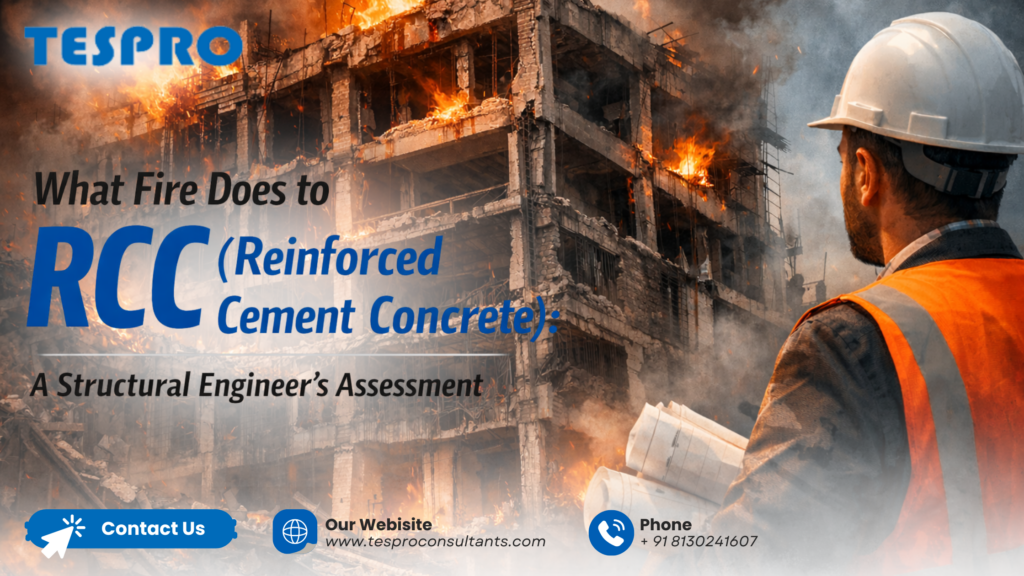
When an RCC building (Reinforced Cement Concrete) undergoes fire, the visible damage may appear limited to soot, cracks, or plaster peeling. However, fire causes irreversible changes to concrete and reinforcement steel, which directly affect the strength, stability, and service life of the structure. Understanding the fire damage to RCC is critical in evaluating long-term safety. From a structural engineer’s perspective, any RCC structure made of Reinforced Cement Concrete exposed to fire for more than a short duration must undergo proper building inspection services before being declared safe. How RCC Behaves During a Fire Reinforced Cement Concrete is a composite material made of: During a fire, both materials react differently to high temperatures, leading to internal distress. This distress significantly impacts the performance of Reinforced Cement Concrete, especially in cases of severe fire damaged buildings. Effect of Fire on Concrete The fire effect on concrete plays a major role in the structural deterioration of Reinforced Cement Concrete members. 1. Loss of Compressive Strength Concrete begins to lose strength at relatively low temperatures: Temperature Impact on Concrete 100–200°C Microcracking begins 300°C Noticeable strength loss 600°C 40–50% strength reduction 800°C+ Concrete becomes brittle and unsafe Even if the member looks intact, the load-carrying capacity of the Reinforced Cement Concrete element is significantly reduced, often requiring fire damage restoration planning. 2. Cracking and Spalling of Concrete Cover Fire causes: Spalling exposes reinforcement steel, accelerating corrosion and reducing fire resistance further. Such fire damage to RCC can severely weaken Reinforced Cement Concrete structures. 3. Change in Concrete Colour (Key Visual Indicator) Colour change helps engineers identify fire severity in Reinforced Cement Concrete structures: These indicators guide testing locations and repair decisions during post fire structural inspection. Effect of Fire on Reinforcement Steel Steel in Reinforced Cement Concrete is highly sensitive to temperature rise: This results in: In many fire damaged buildings, reinforcement deterioration is more critical than surface concrete damage. Loss of Bond Between Steel and Concrete The bond between concrete and reinforcement is critical for Reinforced Cement Concrete performance. Fire leads to: Even without visible bar damage, bond failure alone can make the structure unsafe, which is why building inspection services are essential after fire incidents. RCC Structural Members Most Affected by Fire Structural Element Fire Risk Level Reason Slabs Very High Thin sections heat up quickly Beams Very High Flexural failure risk Columns High Critical load-bearing members Staircases Very High Safety and evacuation concern These structural elements of Reinforced Cement Concrete structures require detailed evaluation after exposure to fire. Why Visual Inspection After Fire Is NOT Enough A common mistake is assuming: These assumptions are structurally dangerous, especially when evaluating fire effect on concrete. A proper post fire structural inspection of Reinforced Cement Concrete must include: Such an assessment is necessary for accurate fire damage restoration decisions. Fire Damaged RCC: Repair or Demolition? Fire-damaged Reinforced Cement Concrete can often be repaired, but only after engineering evaluation and building inspection services. Possible solutions include: Repair without assessment is unsafe and unscientific, particularly in heavily fire damaged buildings. What Should Be Done Immediately After a Fire? Step 1: Safety Measures Step 2: Structural Engineer Inspection Step 3: Decision Making Timely fire damage restoration planning ensures structural safety. Frequently Asked Questions Reinforced Cement Concrete has good fire resistance, but is not fireproof. Prolonged exposure causes serious strength loss and significant fire damage to RCC. Yes, only after a structural audit, detailed evaluation, and professional building inspection services. Depends on member size, cover thickness, and fire duration. Thin Reinforced Cement Concrete members fail faster. No. Plaster repair is cosmetic and does not restore the structural strength affected by the fire effect on concrete. Final Conclusion: Structural Engineer’s Advice Fire damage in Reinforced Cement Concrete is often hidden but always critical. Any RCC building exposed to fire must undergo a professional structural audit and post fire structural inspection before reuse. Decisions based on assumptions in fire damaged buildings can lead to progressive failure or sudden collapse in the future. Has your Reinforced Cement Concrete building undergone fire damage?Do not take risks. Consult a qualified structural engineer before re-occupying the building. Explore more: If planning to build your dream home?Check out Eternal Foundations—a helpful guide to building a strong, safe home that lasts for generations.📩 For a free e-book, email me at kapil.chawla@tesproconsultants.com