
Our structural design methodology is built on a foundation of engineering rigour, code compliance, and practical constructability by a structural engineer in Gurugram and across India, aligned with the engineering design process. We adopt a systematic and analytical approach to ensure that every structure is safe, durable, and optimized for performance and cost efficiency.
Design Philosophy
Our approach to structural design is governed by the following principles of a structural engineer in Gurugram, supported by effective structural planning:
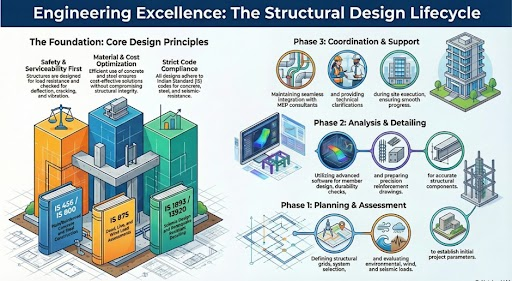
Safety and Reliability
All structures are designed to safely resist applied loads and environmental forces throughout their service life, ensuring strong structural analysis
Serviceability and Performance
Designs are checked for deflection, cracking, and vibration to ensure long-term usability and comfort, based on the structural system of a building.
Economy and Optimization
Efficient use of materials such as concrete and steel to achieve cost-effective solutions without compromising safety through structural design optimization.
Constructability
Designs are developed keeping in mind ease of execution, site conditions, and construction practices, following a robust engineering design process.
Codes and Standards
All structural designs are carried out in accordance with relevant Indian Standard codes and, where required, international best practices by a structural engineer in Gurugram and across India, ensuring compliance within the structural design methodology, including:
- IS 456 – Plain and Reinforced Concrete
- IS 800 – General Construction in Steel
- IS 875 – Dead, Live, Wind Loads
- IS 1893 – Seismic Design
- IS 13920 – Earthquake Resistant Detailing
Design Approach
1. Conceptual Structural Planning
At the initial stage, an efficient structural system of a building is developed in coordination with architectural layouts by a structural engineer in Gurugram. Key considerations include:
- Structural grid and column placement
- Span optimization
- Selection of structural system (RCC / Steel / Composite)
- Load path continuity
This stage establishes the foundation for an efficient and economical design through proper structural planning.
2. Load Assessment and Criteria Definition
All relevant loads are evaluated based on project location and usage as part of the engineering design process:
- Dead loads and superimposed loads
- Live loads based on occupancy
- Wind loads
- Seismic forces
- Equipment and dynamic loads (for industrial structures)
Design criteria such as load combinations, design life, and performance requirements are defined at this stage using detailed structural analysis.
3. Structural Analysis
The structural system is analyzed using advanced engineering software to determine by a structural engineer:
- Bending moments, shear forces, axial forces
- Deflections and drift
- Load distribution across members
- Stability under various load combinations
Both linear and, where required, advanced analysis techniques are adopted for accurate results within the structural design methodology.
4. Member Design and Detailing
All structural components are designed to satisfy strength and serviceability requirements using structural design optimization, including:
- Foundations
- Columns and beams
- Slabs and shear walls
- Steel members and connections
Detailed reinforcement and connection design ensure safe load transfer and durability within the defined structural system of a building.
5. Design for Durability
Durability considerations are incorporated to enhance the lifespan of the structure through proper structural planning:
- Exposure conditions and environmental factors
- Concrete grade and cover requirements
- Corrosion protection measures
- Material selection for aggressive environments
6. Design Optimization
Design iterations are carried out to achieve structural design optimization:
- Reduction in material quantities
- Efficient structural configuration
- Improved construction feasibility
This results in economical and sustainable structural solutions aligned with the engineering design process.
7. Preparation of Detailed Drawings
Comprehensive structural drawings and documents are prepared by a structural engineer in Gurugram and across India, including:
- General arrangement drawings
- Reinforcement detailing
- Foundation layouts
- Steel fabrication drawings
These drawings ensure clarity and precision during construction execution and support effective structural analysis.
8. Coordination and Review
Continuous coordination is maintained with teams following the structural design methodology:
- Architects
- MEP consultants
- Contractors
This ensures seamless integration of structural design with other disciplines and avoids conflicts during execution through efficient structural planning.
9. Construction Stage Support
During the construction phase, we provide support as a structural engineer in Gurugram and all over India, ensuring accuracy in the structural system of a building:
- Technical clarifications
- Review of site modifications
- Support for resolving structural issues
This ensures that the design intent is maintained throughout execution using proper structural analysis.
Explore more: If planning to build your dream home?
Check out Eternal Foundations—a helpful guide to building a strong, safe home that lasts for generations.📩 For a free e-book, email me at kapil.chawla@tesproconsultants.com