
tespro consultants

Structural Safety Assessment

Common Structural Mistakes in Residential Buildings: Insights from Structural Engineer in Delhi

Building a home is a big decision, but many people focus only on design and ignore structure. However, a strong structure is what keeps your home safe for years. A structural engineer in Delhi who works all over India plays a key role in planning safe and stable homes. Because of that, ignoring technical steps like soil testing for construction or the role of structural engineer can lead to serious problems later. Also, regular structural audit of buildings help in identifying risks early. If you ignore structural irregularities in buildings, safety can be compromised. Therefore, a proper structural safety assessment is always important before and after construction. Common Structural Mistakes in Residential Buildings Many homeowners make simple but costly mistakes during construction. Because of that, buildings may face safety issues, cracks, or even failure over time. Lack of Proper Soil Investigation Before Construction Underestimating Load Calculations in Residential Buildings Poor Structural Layout and Column Placement Ignoring Structural Safety for Earthquake Resistance Lack of Proper Structural Drawings and Execution Unauthorized Modifications After Construction Expert Opinion A professional structural audit of buildings ensures your home remains resilient against environmental stress and ageing while maintaining its market value over decades. Therefore, investing in a structural safety assessment is the only way to identify hidden structural irregularities in buildings before they lead to costly repairs or dangerous collapses. Key Structural Components Every Homeowner Should Understand Homeowners should be aware of the primary elements that keep their roof standing. Because every part of the house works as a single unit, you must ensure each component is built with precision. Er. Kapil Chawla, the expert structural engineer at TESPRO Consultants, offers comprehensive structural audit of buildings and safety assessments, ensuring your building is safe and secure for the long term. Explore more: If planning to build your dream home?Check out Eternal Foundations—a helpful guide to building a strong, safe home that lasts for generations.📩 For a free e-book, email me at kapil.chawla@tesproconsultants.com
Why Warehouse Floors Fail – Insights from Structural Audit of Buildings in Noida

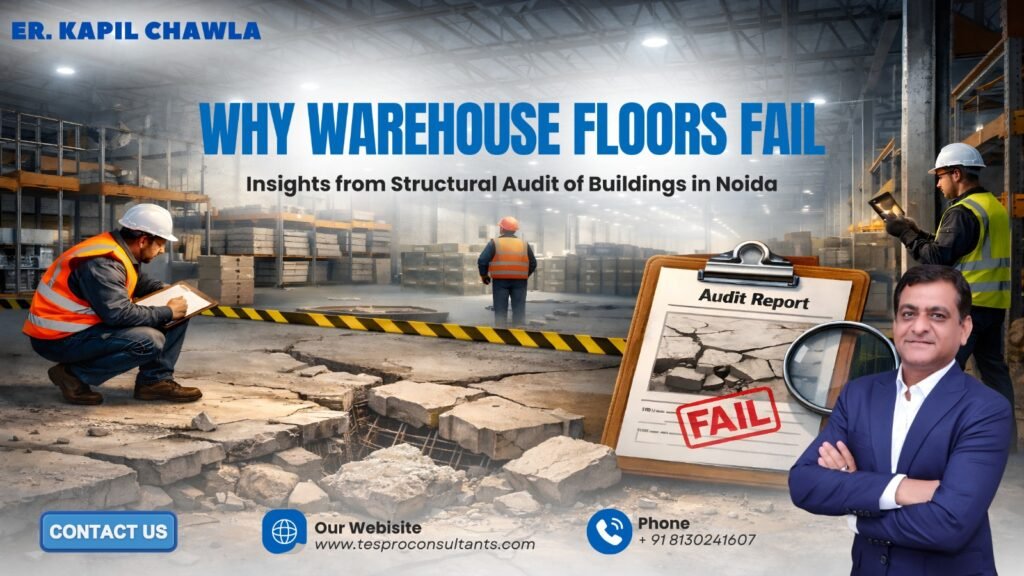
Warehouse floors are designed to withstand heavy loads, continuous movement of forklifts, pallet trucks, and storage racks. Yet, flooring deterioration is one of the most common issues observed during structural audits of industrial buildings in Noida. Cracks, surface dusting, joint failures, and settlement are often ignored initially — but if left unattended, they can lead to operational disruptions, safety hazards, and expensive repairs. This is where a structural audit of buildings in Noida can help identify early signs of damage. Let us understand the major causes. 1. Overloading Beyond Design Capacity Many warehouses change usage over time. Storage loads increase, racking systems become heavier, or machinery is added. If the floor was originally designed for lower loads and is now subjected to: It can lead to cracking, settlement, and joint failure. A structural audit of buildings in Noida can identify these issues before they escalate. Lesson: Floor design load must match operational reality. A structural health assessment helps ensure the load capacity is adequate for current usage. 2. Poor Subgrade Preparation A concrete floor is only as strong as the soil beneath it. Structural safety assessments often reveal issues related to improper subgrade preparation. Common issues include: This results in differential settlement and cracks across the slab. During audits, subgrade failure is one of the most overlooked causes. 3. Inadequate Floor Thickness In heavy-duty warehouses, slab thickness is critical. A structural audit of buildings in Noida often focuses on ensuring that slab thickness meets the required specifications. If the slab thickness is insufficient: Proper design must consider wheel load analysis, impact factors, and load repetitions. 4. Improper Concrete Mix or Poor Workmanship Floor performance heavily depends on concrete quality. During a structural assessment of existing buildings, improper concrete mix or poor workmanship is often identified as a major issue. Common issues include: This leads to surface dusting, abrasion, and reduced durability, which are identified during a building structure audit. 5. Joint Failure and Spalling Warehouse floors contain construction and expansion joints. Structural engineers in Noida often highlight issues related to joint failure in their assessments. Due to: Edges start breaking (spalling), creating operational hazards. Joint distress is often the first visible sign of flooring failure, which is identified during a structural audit of buildings in Noida. 6. Surface Abrasion Continuous forklift movement causes: If a floor hardener was not used or finishing was poor, surface deterioration accelerates. A structural audit of buildings in Noida can detect this problem early. 7. Moisture and Chemical Exposure Absence of vapor barrier can cause: Chemical spills (oils, acids, salts) can further degrade concrete over time. A structural health assessment helps identify moisture-related issues that may affect the integrity of the flooring. 8. Poor Drainage and Water Accumulation Water stagnation softens the subgrade and reduces bearing capacity. This ultimately leads to slab settlement and cracking. Structural safety assessments often uncover poor drainage systems contributing to floor damage. Why Early Assessment Is Critical Warehouse flooring issues are not just cosmetic problems. They can lead to: A professional structural assessment helps identify: Final Thoughts Warehouse flooring deterioration is usually not due to one single cause — it is a combination of design, construction quality, soil behaviour, and operational loading. Regular structural audits of buildings in Noida are essential for identifying issues before they cause significant damage. Periodic structural inspection and load verification can significantly extend the life of industrial flooring systems, ensuring structural integrity and operational efficiency. Explore more: If planning to build your dream home?Check out Eternal Foundations—a helpful guide to building a strong, safe home that lasts for generations.📩 For a free e-book, email me at kapil.chawla@tesproconsultants.com

My Building Is Only 4 Years Old, Part Construction Was Done and Stopped for 3 Years.

Can I Continue Construction as per Old Structural Drawings Without NDT Testing? This is a very common question I receive as a structural engineer: “My building is hardly 4 years old. Only part construction was done, and work was stopped for the last 3 years. Now I want to restart construction exactly as per the old structural drawings. Is NDT testing really required?” At first glance, the answer appears obvious to many clients —“The building is young; nothing should be wrong.” But structural safety does not work on assumptions. Let us understand this with a simple real-life example. The Medical Analogy: A Young, Fit Boy Imagine a 25-year-old boy. Now, without conducting any medical tests — no blood tests, no ECG, no BP check — can even the most experienced physician give a 100% guarantee that everything inside his body is perfectly normal? The answer is NO. Why? Because: Now Replace the Boy with Your Building Your building may be: But internally, several things may have changed. Just like the human body, a building also “ages” when left unattended, and this could affect its structural safety. What Happens to a Partially Constructed Building Left Idle? During the 3 years of construction stoppage, the structure may have experienced: Most of these issues cannot be judged by the naked eye. Therefore, a structural assessment is needed to ensure the building’s integrity. Why Old Structural Drawings Alone Are Not Enough Structural drawings are based on assumed material strengths: But after years of exposure and stoppage: So, continuing the construction, which is already part construction blindly as per the old drawings, is equivalent to: Taking medicines without a diagnosis. What Is NDT Testing and Why Is It Required? Non-Destructive Testing (NDT) helps assess the actual health of the structure without damaging it. Common tests include: These tests help answer critical questions: Concrete strength testing and corrosion in reinforced concrete can be detected through these tests. Real-World Example from Practice I have personally seen cases where: Had part construction continued without testing, the risk of: would have increased significantly. A structural health monitoring process could have prevented these issues. Final Verdict: Is NDT Testing Really Required? Yes. Absolutely. Not because: But because: Just like a doctor relies on tests before certifying health,A structural engineer relies on NDT results before certifying safety. Advice to Building Owners Before restarting part construction: This small step today can: Remember:👉 A building may look healthy, but only tests can confirm its fitness. Don’t skip structural safety assessment or concrete strength testing for your building. Explore more: If planning to build your dream home?Check out Eternal Foundations—a helpful guide to building a strong, safe home that lasts for generations.📩 For a free e-book, email me at kapil.chawla@tesproconsultants.com