tespro consultants

Structural Design

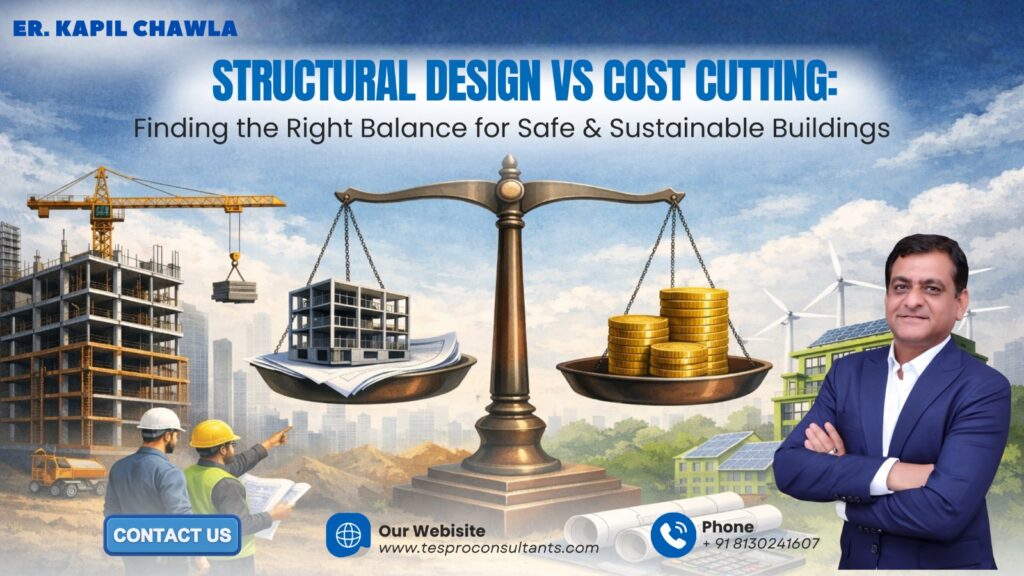
Structural Design vs Cost Cutting: Finding the Right Balance for Safe & Sustainable Buildings

In today’s competitive construction environment, cost-cutting often becomes a primary focus. While controlling project budgets is important, confusing cost-cutting with efficient structural design can lead to serious consequences—from safety risks to long-term financial losses. Understanding the difference between the two is critical for developers, builders, and homeowners alike, especially when considering cost optimization in construction strategies. What Is Structural Design? Structural design is the engineering process of creating a safe, durable, and efficient load-resisting system for a building. Proper structural design building planning ensure stability and performance throughout its lifecycle. It considers: A well-designed structure is not about over-design or under-design—it is about right structure design. What Is Cost Cutting in Construction? Cost-cutting typically involves reducing upfront expenses, often by ignoring proper structural design optimization principles and instead: While this may show immediate savings on paper, it often leads to hidden and recurring costs later, especially when structural safety assessment is overlooked. Structural Design Is Not Cost-Cutting—It Is Cost Optimization A common misconception is that a “cheaper structure” is a “better structure.” In reality, true structure design focuses on engineering accuracy and long-term efficiency. Structural Design Cost Cutting Based on engineering calculations Based on assumptions Optimizes material usage Reduces material blindly Ensures safety & code compliance Often compromises safety Low maintenance over lifecycle High repair & retrofitting costs Long-term value Short-term savings Good structure design actually saves money—not by reducing safety, but by eliminating inefficiencies through proper structural safety assessment and planning. The Hidden Cost of Poor Design Decisions When cost-cutting overrides structural logic and ignores professional structure design practices, projects may face: In seismic zones or industrial structures, such compromises can be catastrophic if structural design codes are not properly followed. Smart Structural Design: Where Savings Truly Come From Experienced structural engineers achieve economy through effective structural design optimization, including: These measures often reduce steel and concrete quantities naturally, supporting cost optimization in construction without risking performance. A Strong Structure Is an Investment, Not an Expense A building stands for decades. Saving a small percentage during construction by weakening structural intent instead of investing in proper structure design can result in multiple times the cost in repairs, retrofits, and downtime later. The cheapest structure is often the most expensive one in the long run, especially when structural design building fundamentals are ignored. Final Thoughts Structure design and cost-cutting are not opposing concepts, but they must be clearly distinguished. Choosing the right structural engineer ensures your project is economical, safe, and future-ready—backed by proper structural safety assessment and compliance with structural design codes. If you’re planning a new project or reviewing an existing structure, invest in proper structure design—not shortcuts. A strong structure design today ensures peace of mind and savings tomorrow. Need help with value engineering, structural audits, or optimized designs? Let’s build smart, safe, and sustainable with the right structure design approach. Explore more: If planning to build your dream home?Check out Eternal Foundations—a helpful guide to building a strong, safe home that lasts for generations.📩 For a free e-book, email me at kapil.chawla@tesproconsultants.com

Different Types of Structures a Structural Engineer Can Design in India

India’s diverse geography, varying climate zones, and rapid urbanization demand a wide range of specialized engineering solutions. From high-rise buildings in metro cities to massive industrial plants, the expertise of structural engineers is essential to ensuring safety and longevity. The importance of structural design cannot be overstated; it is the backbone of any project, ensuring that every building can withstand natural forces. This blog highlights the major types of structures a structural engineer can design in India, along with their applications and key design considerations. 1. Residential Projects: Crafting Safe Homes for Indian Families Focus: Indian Home Construction & Residential Safety Residential buildings form a massive portion of the workload for a  structural engineer. Whether it is a luxury villa or a multi-story apartment, ensuring a safe structural design is the top priority to protect lives and investments. 2. Commercial Buildings: Building the Foundations of Modern Business Focus: Long Spans and Flexible Structural Design Commercial structures require flexible layouts and the ability to support higher live loads compared to standard Indian home construction. 3. Industrial Structures: Engineering Strength for Heavy Manufacturing Focus: Precision and Speed in Industrial Structural Design Industrial projects demand precision and heavy-load handling capacity. Structural engineers working in this sector often deal with specialized materials and fast-track construction methods like PEB. 4. Institutional Buildings: Designing Durable Spaces for the Public Focus: High-Density Safety and Structural Resilience These buildings are designed with a focus on public safety and a very long service life. structural engineers implement higher safety margins here to ensure these facilities remain functional during emergencies. 5. Infrastructure Projects: Connecting India Through Expert Engineering Focus: Transportation Networks and National Growth Infrastructure development is a primary driver of the construction industry. Structural engineers in this sector design the arteries of the nation, ensuring they can handle the heavy demands of a growing population. 6. Hydraulic Structures: Mastering Water Pressure and Containment Focus: Specialized Leak-Proof Structural Design Water structures require strict crack-control and specialized serviceability checks to prevent leakage and chemical corrosion over time. 7. Special Heavy Structures: Tackling Complex Engineering Horizons Focus: Advanced Analysis for Unique Structural Forms These structures involve complex loading patterns and advanced mathematical analysis. A structural engineer must use sophisticated software to model these unique, often slender builds against high wind speeds. 8. Retrofitting & Rehabilitation: Giving Old Buildings New Life Focus: Strengthening and Restoring Structural Integrity A structural engineer also works on existing buildings to extend their lifespan or upgrade their strength to meet modern safety standards. 9. Temporary Structures: Ensuring Safety During the Construction Phase Focus: Support Systems for Successful Project Completion Often overlooked, these structures are critical for site safety. Even during the initial stages of Indian home construction, temporary supports must be engineered to prevent accidents. Why Professional Engineering is the Key to Success A structural engineer in India works across a wide spectrum of projects, ensuring that every build—from a small house to a massive bridge—is resilient. Each structure type demands sound engineering judgment, strict code compliance, and an intimate understanding of local soil and climate conditions. With India’s growing focus on safety and smart infrastructure, the role of structural engineers continues to expand, making professional structural design one of the most impactful professions in the built environment today. Need Professional Structural Design Services? If you’re looking for a structural engineer for home construction or a large-scale industrial project, ensuring a safe structural design starts with the right partner.

Basic Engineering vs Detailed Engineering in Structural Design

In structural design projects, especially in industrial, infrastructure, and commercial buildings, engineering work is broadly divided into basic engineering and detailed engineering. Understanding the difference between these two stages is crucial for clients, architects, project managers, and even young engineers, as each stage serves a distinct purpose and level of decision-making in structural design. What is Basic Engineering in Structural Design? Basic engineering is the conceptual and feasibility stage of a structural engineering project. It establishes the overall structural design scheme and confirms whether the proposed structure is safe, viable, and economical. Key Objectives of Basic Engineering Typical Deliverables in Basic Engineering Where Basic Engineering is Used Note: Basic engineering drawings are not meant for construction. What is Detailed Engineering in Structural Design? Detailed Engineering is the stage where concepts are converted into construction-ready documents. It involves precise analysis, exact member sizing, reinforcement detailing, and coordination with other disciplines, following the engineering design process. Key Objectives of Detailed Engineering Typical Deliverables in Detailed Engineering Where Detailed Engineering is Used Key Differences Between Basic and Detailed Engineering Aspect Basic Engineering Detailed Engineering Purpose Concept & feasibility Construction-ready design Level of detail Approximate Exact & precise Drawings Conceptual layouts Fully detailed drawings Calculations Preliminary Complete & member-wise Cost accuracy ±20–30% ±5–10% Construction use Not suitable Mandatory Time required Shorter Longer Why Both Stages Are Equally Important Skipping or diluting Basic Engineering often leads to: Skipping Detailed Engineering results in: A well-executed project always respects both stages as complementary, not optional. A structural design engineer ensures that all steps are correctly followed, ensuring safety and feasibility. Practical Insight from Real Projects In many industrial and PEB projects, only basic engineering is issued initially, while fabrication and erection drawings are prepared by contractors. If basic assumptions are unclear or incomplete, this can lead to: A clear scope definition between basic engineering and detailed engineering helps avoid such conflicts. Conclusion Basic Engineering defines what to build.Detailed Engineering defines how to build it safely and efficiently. Both stages together form the foundation of reliable structural design. For clients and engineers alike, understanding this distinction ensures better planning, cost control, and structurally sound outcomes. Explore more: If planning to build your dream home?Check out Eternal Foundations—a helpful guide to building a strong, safe home that lasts for generations.📩 For a free e-book, email me at kapil.chawla@tesproconsultants.com
Increasing Awareness in Structural Engineering for Small Home Owners

In India, home construction is not a frequent activity, especially in indian home construction practices. For most families, it is a once-in-a-lifetime investment built with years of savings, dreams, and emotions attached to it. However, while people spend considerable time selecting tiles, paint colours, and interiors, the role of structural engineering and overall structural engineering in ensuring safety is often ignored, and the structural safety of the house receives the least attention. This lack of awareness can lead to serious long-term risks and highlights the importance of structural design. Why Structural Engineering Matters for Small Houses There is a common misconception that structural engineering and structural engineers are required only for high-rise buildings or large commercial projects. In reality, small residential houses are more vulnerable because: A structural engineering professional ensures that the building can safely carry its own weight, live loads, and resist natural forces like earthquakes and wind. Home Construction Is a One-Time Decision Unlike commercial projects, where design and construction teams are experienced, individual homeowners depend heavily on contractors and local practices. Any error in foundation, column sizing, or reinforcement detailing becomes extremely expensive—or sometimes impossible—to rectify later without safe structural design principles. A structurally weak building may not fail immediately, but it slowly loses its strength, leading to: Common Myths Among Home Owners 1. “Using more steel makes the building safer” Safety does not come from quantity alone. Proper design, detailing, and placement of reinforcement based on structural engineering principles are far more important than excess steel. 2. “My neighbour’s design worked, so it will work for me” Soil conditions, plot size, and loading patterns vary even within the same locality. Copying designs without professional structural engineering input is one of the most common and dangerous practices. 3. “Soil testing is optional” Soil testing forms the foundation of safe construction. Without knowing soil bearing capacity, foundation design becomes guesswork and increases structural risk. The Hidden Risks in Small Residential Buildings Many issues remain hidden behind plaster and finishes: These deficiencies may not be visible, but significantly reduce the building’s safety margin. What a Structural Engineer Actually Does A qualified structural engineer: Their role is not limited to drawings; it is about risk mitigation and safety assurance. Cost vs Long-Term Value Structural design fees typically account for only 1–2% of the total construction cost, yet they directly influence: Skipping professional structural input may appear economical initially, but it often results in higher costs later. Role of Awareness in Building Safer Homes An aware homeowner asks the right questions: Awareness empowers homeowners to demand quality and accountability in construction decisions. Conclusion Structural engineering is not a luxury reserved for large projects. Every home, irrespective of size, deserves a safe and well-engineered structure. Increasing awareness among small homeowners is essential for building resilient communities and reducing avoidable construction failures. A strong home begins with informed decisions. Explore more: If planning to build your dream home?Check out Eternal Foundations—a helpful guide to building a strong, safe home that lasts for generations.📩 For a free e-book, email me at kapil.chawla@tesproconsultants.com
Use of BIM in Structural Design: Transforming the Way We Build

In today’s fast-evolving construction industry, Building Information Modeling (BIM) has become more than just a digital tool—it is a complete process that enhances accuracy, collaboration, and efficiency in structural design and structural engineering. Whether working on small residential projects or large commercial developments, BIM is reshaping how structural designers plan, analyse, and deliver projects by supporting building information modeling and improving the benefits of BIM. 1. Improved Visualization and Design Accuracy Traditional 2D drawings have limitations in conveying complex structural design details. BIM removes these constraints by offering a 3D intelligent model that clearly represents beams, columns, slabs, foundations, reinforcement, and connections, making structural analysis smoother for teams. 2. Early Clash Detection and Error Reduction One of the biggest advantages of BIM is its ability to automatically detect conflicts between structural, architectural, and MEP components, which directly improves structural design outcomes. Examples include: Identifying clashes early reduces: This results in a more efficient and predictable project using BIM for construction. 3. Seamless Collaboration Between Teams BIM establishes a Common Data Environment (CDE) where all consultants—architects, structural engineers, MEP designers, and contractors—contribute to the same model for enhanced structural design workflows. Benefits: This collaboration ensures faster decision-making and better project outcomes supported by building information modeling. 4. Accurate Structural Analysis and Design Integration Modern BIM platforms integrate directly with analysis software like ETABS, STAAD, SAP2000, and Robot, allowing seamless coordination in structural design tasks. This allows: Such integration boosts accuracy and supports the overall benefits of BIM. 5. Quantity Take-Offs and Cost Optimization With BIM, quantity extraction becomes automatic and highly accurate, offering great value to structural design teams. Engineers can quickly compute: This enhances cost estimation, avoids overruns, and improves project budgeting through BIM for construction. 6. Better Construction Planning and Sequencing BIM enables 4D (Time) and 5D (Cost) simulations, helping teams plan every stage of structural design execution. Structural engineers and contractors can: The result is a smoother construction workflow supported by building information modeling and the wider benefits of BIM. 7. Enhanced Documentation and Record Management BIM models become a lifelong digital record of the structure—useful for facility management, maintenance, and future modifications in structural design projects. It provides: This adds significant long-term value for clients and facility managers. 8. Sustainable and Safer Designs With BIM, structural engineers can simulate: This helps in designing safer, stronger, and more sustainable structures through improved structural design and enhanced structural analysis workflows. Conclusion The use of BIM in structural design is no longer optional—it is becoming an industry standard. From enhancing accuracy and collaboration to reducing costs and improving project timelines, BIM empowers structural engineers to work smarter and deliver higher-quality results backed by the strong benefits of BIM and the power of building information modeling. Firms that adopt BIM today will lead the way in efficiency, innovation, and client satisfaction tomorrow, especially with the growth of BIM for construction across the industry. Explore more: If planning to build your dream home?Check out Eternal Foundations—a helpful guide to building a strong, safe home that lasts for generations.📩 For a free e-book, email me at kapil.chawla@tesproconsultants.com

Be Clear in Your Proposal: Define Scope to Avoid Delays, Disputes & Cost Overruns in Structural Design

In the world of Structural Design, structural engineering, and construction, clarity is not just a best practice — it is a requirement. A well-defined proposal lays the foundation for smooth execution, minimises disputes, and ensures that both the client and consultant share the same expectations from day one. Yet, many structural design projects face delays, confusion, additional revisions, change orders, or even payment disputes — not because of technical issues, but due to unclear scope definitions and missing inputs from clients. Clear structural planning and proper architectural planning are essential to avoid these concerns. Why Scope Clarity Matters When the scope of work is not clearly defined at the proposal stage, misunderstandings easily arise. Statement like: …lead to unnecessary friction. A clear proposal eliminates assumptions and ensures that every stakeholder understands:• What is included• What is excluded• Who is responsible for what• What information is required and when• What triggers extra cost or extended timelines All of this becomes even more important when dealing with Structural Design and detailed structural analysis processes. What Should Be Included in a Structural Design Scope? A comprehensive proposal should clearly list: Scope of Works Included Examples may include:• Structural analysis and design of building components (footings, columns, beams, slabs, shear walls, etc.)• Preparation of construction drawings• General notes and specifications• One round of design iteration based on architectural planning revisions (if agreed)• Coordination meetings (limited as per proposal) Scope Exclusions This is equally — sometimes more — important. Examples:• Soil investigation/geotechnical report• Architectural planning redesigns or frequent revisions• Value engineering after final design submission• Site supervision or proof-checking by third parties• Specialty design items (façade, steel staircase, post-tensioning, seismic retrofitting, etc.)• BIM modelling (unless specified) Clearly stating exclusions avoids the most common conversation in the industry: “This is also included in your scope, right?” Client Inputs That Impact Design Timeline Many Structural Design activities depend directly on client-provided information. If inputs are delayed, the design gets delayed — and the project timeline and cost begin to shift. Required Client Input Impact if Missing Final approved architectural drawings Rework, wrong assumptions, multiple revisions Soil test report Unable to finalise foundation sizes Local codes & authority requirements Non-compliance and redesign Loads from services (HVAC, solar, equipment, tanks, machinery) Under/overdesign and redesign Survey plan & site constraints Incorrect structural planning A good proposal must state: “Design timelines start only after receipt of all required inputs in final format.” Timelines, Revisions & Responsibilities Include clauses such as:• Expected duration for submission after final data receipt• Number of design revisions included (1 major + 1 minor, for example)• Revisions due to architectural planning changes are additional charges• Additional meetings, authority revisions, value engineering, tender support — chargeable separately This ensures boundaries remain intact throughout the project lifecycle and supports smoother structural engineering workflows. Avoiding Cost Overruns Lack of clarity often results in:• Additional redesign hours• Unplanned coordination meetings• Authority submission revisions• Disputes over deliverables Clear contractual language helps justify cost variations. Suggested wording: “Any redesign required due to a change in architectural planning, client instruction, or delayed inputs will be considered an additional service and charged as per the approved rate schedule.” Final Message: Clarity Prevents Conflict A well-drafted proposal is not a formality — it is a professional safeguard. It protects:• The designer (from scope creep and unpaid work)• The client (from surprises, delays, and budget uncertainty)• The project (from miscommunication and redesign cycles) In Structural Design and structural engineering, clarity in scope is as important as clarity in calculations. Proper structural planning, correct architectural planning, and accurate structural analysis ensure that the project moves forward without delays or disputes. One Line Summary: Define scope clearly, list exclusions, state client responsibilities, and document timelines — because clear proposals create smoother Structural Design projects. Explore more: If planning to build your dream home?Check out Eternal Foundations—a helpful guide to building a strong, safe home that lasts for generations.📩 For a free e-book, email me at kapil.chawla@tesproconsultants.com
Types of Steel Used in Building Construction: A Complete Guide

Steel plays a major role in building construction because it determines how strong, safe, and long-lasting a structure will be. Two bars may look similar, but their real performance varies, so the right grade must match the project’s structural design. With proper planning, the choice of steel supports accurate structural testing and helps your structural consultant create a stable framework for the overall design of steel structure. Here is a simple and practical guide to the steel grades widely used in building construction, including Fe415, Fe500, Fe500D, Fe500S, Fe550, CRS, TMT, and HYSD. Steel Grades and Their Applications in Building Construction 1. Fe415 vs Fe500 – The Commonly Used Grades Fe415 Fe415 is mostly used in small homes and low-rise buildings. It bends well and handles lighter loads effectively. Best for:• Small residential buildings• Low-load structures Fe500 Fe500 has become the preferred choice in modern building construction because it gives more strength and reduces steel usage without compromising safety. Benefits:• Higher tensile strength• Lower steel consumption• Better economy Simply put, Fe500 offers more strength per kilogram and keeps the structure dependable. 2. Fe550 – Higher Strength for Heavy Loads Fe550 is chosen where structures need greater load capacity. Its strength makes it useful in demanding areas of building construction. Common uses:• Industrial buildings• Warehouses• Long-span beams• Bridges• Congested reinforcement zones Note:Fe550 has slightly lower ductility, so it’s avoided in high seismic zones unless Fe550D is available. 3. Fe500D and Fe500S – Made for Safety Fe500D Fe500D provides higher ductility and fewer impurities. It bends safely under sudden loads and reduces crack formation. Fe500S Fe500S is ideal for earthquake-prone areas. It combines strength and flexibility, which helps buildings face dynamic forces. Best for:• High-rise buildings• Seismic Zones III–V• Structures facing vibrations Better ductility equals better safety. 4. CRS – Corrosion Resistant Steel CRS is designed to reduce corrosion caused by salt, moisture, or chemicals. It is used in areas where the environment affects steel performance. Recommended for:• Coastal and marine regions• Water tanks• Treatment plants• Industrial and humid areas CRS increases building life and reduces long-term maintenance. 5. TMT vs HYSD – Why TMT Wins HYSD (Old Technology) • Manufactured with cold twisting• More brittle• Weak during earthquakes TMT (Modern Technology) • Strong outer core + soft inner core• High ductility• Excellent earthquake resistance• Better concrete bonding TMT bars have replaced HYSD in almost all modern building construction projects. 6. Why Price Should Not Decide the Steel Steel should never be chosen based only on price because it directly affects safety and performance. Cheaper options often lead to long-term issues. Possible problems:• Cracks• Corrosion• High repair costs• Poor earthquake performance• Shorter building life Choosing the right steel grade ensures long-term construction safety, reliability, and peace of mind. Final Thoughts Selecting the right grade of steel ensures:✔ Safer structural elements✔ Better earthquake protection✔ Longer building life✔ Lower maintenance✔ Reduced congestion in beams and columns Grade Recommended Use/Application Fe415 Simple, low-rise structures Fe500 Standard for most projects Fe500D / Fe500S Best for safety and seismic zones Fe550 Heavy loads and long spans CRS Corrosion-prone regions TMT Modern and widely preferred Good steel is the core of strong building construction. When chosen with proper engineering and guidance, your structure stays safe and durable for decades.

When Too Many Stakeholders Are Involved — Structural Design Must Be Coordinated With One Technical Person

In many projects today, especially in multi-storied buildings, industrial plants, or large institutional works, too many people try to manage the design coordination — project managers, site engineers, architects, contractors, and even client-side representatives. While everyone intends to help, the result is often the opposite: confusion, conflicting instructions, and design misinterpretations in the overall structural design process. Structural design is not a democratic process — it’s a technical discipline that relies on clear communication and precise data. When messages, revisions, or clarifications start flowing through multiple channels, the accuracy of information drops drastically, slowing down the design approval process and increasing the chances of errors. A single change in beam size, wall thickness, or foundation level may have a chain reaction throughout the structure. If that information doesn’t reach the structural engineer in its correct form — or reaches from three different people with three different versions — it becomes a recipe for errors that affect the project design and its execution timeline. Why It Matters The Better Way For any project — whether small or large — the structural design engineer should coordinate only with one designated technical person from the client or project management team. This person must be: A Simple Rule That Saves Projects In short: Too many voices create technical noise. Structural design engineers don’t need multiple opinions — they need one clear line of communication to ensure that safety, stability, and efficiency are never compromised. Let every project adopt this principle —“All structural design coordination must be through one technical person only.”It’s simple, practical, and saves both time and mistakes. Explore more: If planning to build your dream home?Check out Eternal Foundations—a helpful guide to building a strong, safe home that lasts for generations.📩 For a free e-book, email me at kapil.chawla@tesproconsultants.com