

tespro consultants

Structural Assessment of Existing Buildings

Structural Engineer in Delhi: Why Professional Structural Design is Essential for Safe Construction

Building a house, commercial complex, or industrial structure is a major investment. While architectural design determines a building’s appearance, structural engineering ensures it is safe, stable, and durable. For this reason, consulting a structural engineer in Delhi becomes extremely important during construction planning. Many people underestimate the importance of structural design and professional structural planning. However, the role of a structural engineer in Delhi is crucial in ensuring that a building can safely withstand loads, environmental forces, and long-term usage. Engaging an experienced structural consultant in Delhi NCR, such as Er. Kapil Chawla from Tespro Consultants, can help ensure that your building is designed efficiently, safely, and economically. What Does a Structural Engineer Do? A structural engineer in Delhi is responsible for designing a building’s structural framework, ensuring it can safely support various loads without failure. Structural engineers and every structural design engineer design and analyze key elements such as These components form the backbone of the building and must be carefully designed to ensure stability and durability. Importance of Structural Design in Building Construction 1. Ensuring Safety of the Building The primary responsibility of a structural engineer in Delhi is to ensure that the building can safely withstand different loads, such as the following: Proper structural design ensures that the building remains safe under these conditions. 2. Optimizing Construction Costs Contrary to common belief, professional structural design can actually reduce construction costs. An experienced structural engineer in Delhi optimizes the use of materials such as steel and concrete, ensuring that the structure is neither overdesigned nor underdesigned. Efficient structural design can significantly reduce unnecessary material use, saving considerable money during construction. 3. Proper Foundation Design The foundation is the most critical component of any building. The foundation transfers the entire structure’s load to the soil. Improper foundation design can lead to problems such as: Structural engineers analyze soil conditions and design the foundation accordingly to ensure safe load transfer. 4. Preventing Structural Failures Structural failures often occur due to poor design, improper detailing, or construction mistakes. Professional structural engineers provide: These measures help prevent structural failures and ensure long-term durability. Role of Structural Engineers in Residential Buildings Many homeowners believe that small residential buildings do not require professional structural design. However, even a G+2 or G+3 residential building requires proper structural planning from a structural engineer in Delhi. Structural engineers help with: Professional structural design ensures that the house remains safe and durable for decades. Structural Health Assessment of Existing Buildings Structural engineers also play a vital role in conducting structural health assessments and structural assessments of existing buildings. Over time, buildings may experience deterioration due to factors such as: Structural health assessments help identify potential issues before they become serious problems. Use of Non-Destructive Testing in Structural Audits Modern structural engineering uses several Non-Destructive Testing (NDT) techniques to assess the condition of concrete structures. Some commonly used tests include: These tests help engineers evaluate structural conditions without damaging the structure. Choosing the Right Structural Engineer Selecting the right structural engineer is critical for the success of a construction project. A good structural consultant should have: Working with experienced professionals such as Er. Kapil Chawla ensures that the building is designed with the right balance of safety, efficiency, and cost-effectiveness. Why Professional Structural Design Matters Investing in professional structural design offers several advantages: In the long run, professional structural engineering services help protect both your investment and the safety of occupants. Conclusion Structural engineering is one of the most critical aspects of building construction. Proper structural design ensures that buildings remain safe, durable, and economical throughout their life cycle. Whether you are planning a residential building, commercial project, or structural assessment of existing buildings, consulting experienced professionals like Tespro Consultants can help ensure reliable and efficient structural solutions. With expert guidance from Er. Kapil Chawla, clients receive professional structural design services that focus on safety, efficiency, and performance from a trusted structural engineer in Delhi. Explore more: If planning to build your dream home?Check out Eternal Foundations—a helpful guide to building a strong, safe home that lasts for generations. 📩 For a free e-book, email me at kapil.chawla@tesproconsultants.com
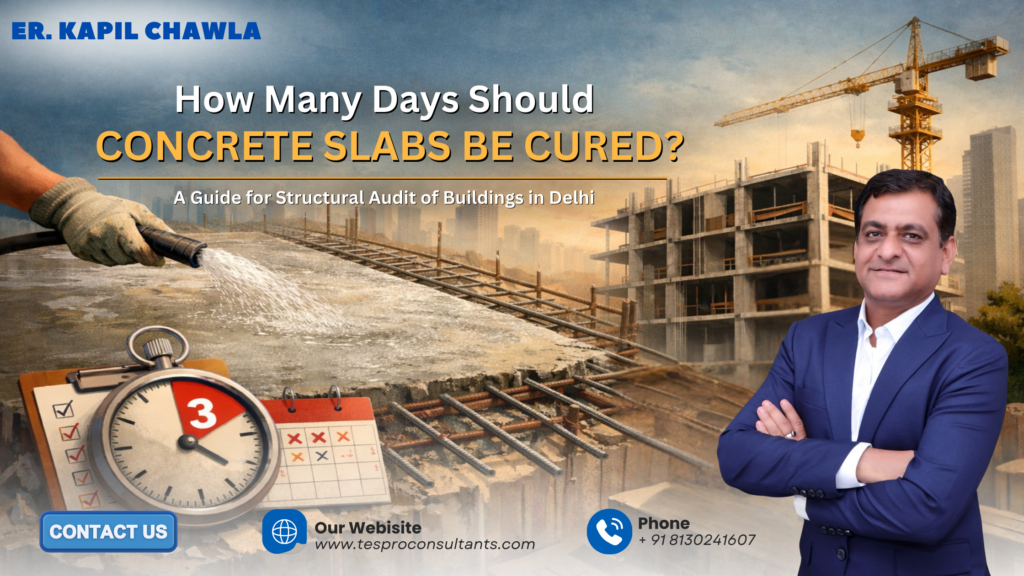
How Many Days Should Concrete Slabs Be Cured? A Guide for Structural Audit of Buildings in Delhi

Concrete curing is one of the most important steps in slab construction. Yet, on many sites, curing is either reduced or stopped early — leading to cracks, dusting, and durability issues, which can later become serious concerns during a structural audit of buildings in Delhi, where engineers evaluate reinforced concrete durability. If you are a homeowner, contractor, or industrial warehouse owner, this guide explains the correct curing duration for RCC slabs and Trimix concrete flooring as per Indian standards. Proper curing is essential in RCC construction, and poor curing often becomes visible during the structural assessment of existing buildings. What Is the Minimum Curing Period for Concrete Slabs? As per IS 456 issued by the Bureau of Indian Standards, the minimum curing duration depends on the cement type, which directly affects concrete strength estimation during engineering evaluations. Minimum curing period: 7 days Minimum curing period: 10 days Blended cement requires longer curing because hydration is slower, which plays an important role in maintaining reinforced cement concrete performance and long-term durability. Recommended Curing Duration (Best Practice in Indian Conditions) Due to high temperatures and rapid moisture loss in India, the recommended curing period for slabs is longer than the minimum code requirement, which is often highlighted during a structural audit of buildings in Delhi when experts review slab performance. Type of Slab Recommended Curing Duration Residential RCC Slab 10 days Roof Slab (Sun Exposed) 10–14 days Industrial Floor Slab 14 days Water Tank Slab 14 days minimum Trimix Flooring 14 days strongly recommended Concrete continues gaining strength for 28 days and beyond — but only if adequate moisture is maintained, which improves reinforced concrete durability in long-term structural performance. Curing for Trimix Concrete Flooring (Industrial Slabs) Trimix flooring is widely used in industrial RCC construction projects, such as: Since Trimix involves mechanical vibration and surface finishing, the top surface becomes dense and smooth — but also highly vulnerable to early moisture loss, which can later be identified during the structural assessment of existing buildings. Why Proper Curing Is Critical for Trimix Floors: Common Problems Due to Poor Curing: Best Practice for Trimix Curing: These practices help maintain proper reinforced cement concrete strength and durability. Why Concrete Slabs Need Longer Curing Slabs are more exposed compared to beams and columns because: Improper curing reduces durability even if cube strength appears satisfactory, which is why engineers carefully study curing history during concrete strength estimation and structural audit of buildings in Delhi. Final Recommendation Minimum curing is not equal to ideal curing. For long-term performance, crack control, and durability — especially in Indian climate conditions — 10–14 days curing for slabs and 14 days for Trimix flooring is strongly recommended. Proper curing significantly improves reinforced concrete durability, which is often evaluated during a structural audit of buildings in Delhi. Proper curing ensures: If you are planning: Or require a structural audit of buildings in Delhi to check safety, durability, and structural assessment of existing buildings, feel free to connect for professional guidance. Explore more: If planning to build your dream home?Check out Eternal Foundations—a helpful guide to building a strong, safe home that lasts for generations.📩 For a free e-book, email me at kapil.chawla@tesproconsultants.com
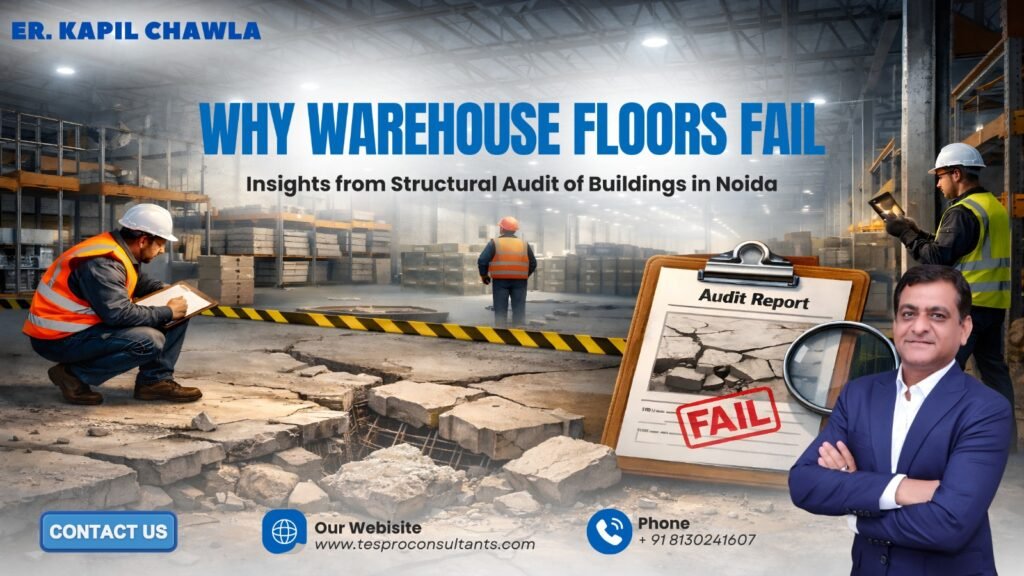
Why Warehouse Floors Fail – Insights from Structural Audit of Buildings in Noida

Warehouse floors are designed to withstand heavy loads, continuous movement of forklifts, pallet trucks, and storage racks. Yet, flooring deterioration is one of the most common issues observed during structural audits of industrial buildings in Noida. Cracks, surface dusting, joint failures, and settlement are often ignored initially — but if left unattended, they can lead to operational disruptions, safety hazards, and expensive repairs. This is where a structural audit of buildings in Noida can help identify early signs of damage. Let us understand the major causes. 1. Overloading Beyond Design Capacity Many warehouses change usage over time. Storage loads increase, racking systems become heavier, or machinery is added. If the floor was originally designed for lower loads and is now subjected to: It can lead to cracking, settlement, and joint failure. A structural audit of buildings in Noida can identify these issues before they escalate. Lesson: Floor design load must match operational reality. A structural health assessment helps ensure the load capacity is adequate for current usage. 2. Poor Subgrade Preparation A concrete floor is only as strong as the soil beneath it. Structural safety assessments often reveal issues related to improper subgrade preparation. Common issues include: This results in differential settlement and cracks across the slab. During audits, subgrade failure is one of the most overlooked causes. 3. Inadequate Floor Thickness In heavy-duty warehouses, slab thickness is critical. A structural audit of buildings in Noida often focuses on ensuring that slab thickness meets the required specifications. If the slab thickness is insufficient: Proper design must consider wheel load analysis, impact factors, and load repetitions. 4. Improper Concrete Mix or Poor Workmanship Floor performance heavily depends on concrete quality. During a structural assessment of existing buildings, improper concrete mix or poor workmanship is often identified as a major issue. Common issues include: This leads to surface dusting, abrasion, and reduced durability, which are identified during a building structure audit. 5. Joint Failure and Spalling Warehouse floors contain construction and expansion joints. Structural engineers in Noida often highlight issues related to joint failure in their assessments. Due to: Edges start breaking (spalling), creating operational hazards. Joint distress is often the first visible sign of flooring failure, which is identified during a structural audit of buildings in Noida. 6. Surface Abrasion Continuous forklift movement causes: If a floor hardener was not used or finishing was poor, surface deterioration accelerates. A structural audit of buildings in Noida can detect this problem early. 7. Moisture and Chemical Exposure Absence of vapor barrier can cause: Chemical spills (oils, acids, salts) can further degrade concrete over time. A structural health assessment helps identify moisture-related issues that may affect the integrity of the flooring. 8. Poor Drainage and Water Accumulation Water stagnation softens the subgrade and reduces bearing capacity. This ultimately leads to slab settlement and cracking. Structural safety assessments often uncover poor drainage systems contributing to floor damage. Why Early Assessment Is Critical Warehouse flooring issues are not just cosmetic problems. They can lead to: A professional structural assessment helps identify: Final Thoughts Warehouse flooring deterioration is usually not due to one single cause — it is a combination of design, construction quality, soil behaviour, and operational loading. Regular structural audits of buildings in Noida are essential for identifying issues before they cause significant damage. Periodic structural inspection and load verification can significantly extend the life of industrial flooring systems, ensuring structural integrity and operational efficiency. Explore more: If planning to build your dream home?Check out Eternal Foundations—a helpful guide to building a strong, safe home that lasts for generations.📩 For a free e-book, email me at kapil.chawla@tesproconsultants.com

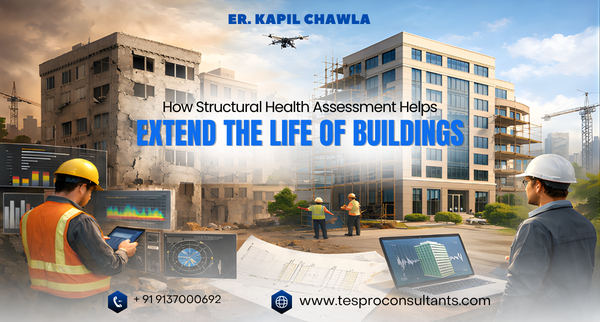
How Structural Health Assessment Helps Extend the Life of Buildings

Buildings are long-term assets. Whether residential, commercial, or industrial, their safety and performance depend not only on good design and construction but also on timely evaluation and maintenance. One of the most effective tools to achieve this is a Structural Health Assessment. A proper structural health assessment ensures that hidden risks are identified before they become serious threats. Structural failures rarely occur suddenly. In most cases, buildings show early warning signs—cracks, corrosion, deflections, seepage, or changes in load usage—that go unnoticed or ignored. Structural Health Assessment helps identify these issues at an early stage, allowing corrective action before damage becomes critical or irreversible, ensuring overall structural safety assessment. What Is Structural Health Assessment? Structural Health Assessment is a systematic evaluation of an existing structure to determine its current condition, load-carrying capacity, durability, and remaining service life. It is an essential part of the structural assessment of existing buildings and combines: The objective is not only to assess safety but also to optimize repair, strengthening, and maintenance strategies through proper non destructive testing methods. Why Buildings Deteriorate Over Time All buildings are subjected to gradual deterioration due to multiple factors, which is why a structural audit of buildings becomes necessary: Without periodic Structural Health Assessment, these issues accumulate silently, reducing the building’s effective lifespan. How Structural Health Assessment Extends Building Life 1. Early Detection of Hidden Defects Non-destructive tests help identify internal issues such as low concrete strength, voids, honeycombing, corrosion, and cracks that are not visible externally. Early detection through structural health assessment allows targeted repairs instead of large-scale rehabilitation later. 2. Prevention of Progressive Damage Minor defects left unattended often lead to major failures. For example, corrosion starts locally but gradually spreads, weakening the entire structural system. Structural Health Assessment helps arrest deterioration at an early stage, preventing progressive damage and supporting long-term structural safety assessment. 3. Optimized Repair and Retrofitting Instead of blanket repairs, Structural Health Assessment enables engineering-based solutions—repairing only what is required and strengthening only critical elements. This reduces unnecessary expenditure and improves the effectiveness of interventions in the structural assessment of existing buildings. 4. Validation of Structural Capacity Many older buildings were designed for loads much lower than present-day requirements. Structural assessment verifies whether the structure can safely support: If deficiencies are identified through a structural audit of buildings, retrofitting measures can be implemented to safely extend usability. 5. Improved Safety and Compliance Regular assessments ensure that buildings meet acceptable safety standards and comply with statutory requirements. This is especially important for housing societies, commercial complexes, hospitals, schools, and industrial buildings, where structural safety assessment plays a critical role. 6. Cost Savings Over the Building Lifecycle Preventive assessment is significantly more economical than emergency repairs or reconstruction. Timely Structural Health Assessment: This makes structural health assessment a proactive and financially wise decision. 7. Extension of Service Life With proper assessment, maintenance, and strengthening through Structural Health Assessment, buildings can safely perform 20–30 years beyond their originally assumed service life. This sustainability benefit reduces the need for new construction and conserves resources. When Should Structural Health Assessment Be Conducted? Structural Health Assessment is recommended: It forms a critical part of the long-term structural audit of buildings. Conclusion Structural Health Assessment is not an expense—it is a strategic investment in safety, durability, and sustainability. By identifying problems early, validating structural capacity, and guiding effective repairs, it plays a critical role in extending the life of buildings and safeguarding occupants. In an era where aging infrastructure is a growing concern, periodic structural health assessment should be treated as an essential part of responsible building ownership and management. Explore more: If planning to build your dream home?Check out Eternal Foundations—a helpful guide to building a strong, safe home that lasts for generations.📩 For a free e-book, email me at kapil.chawla@tesproconsultants.com