
tespro consultants

concrete strength estimation

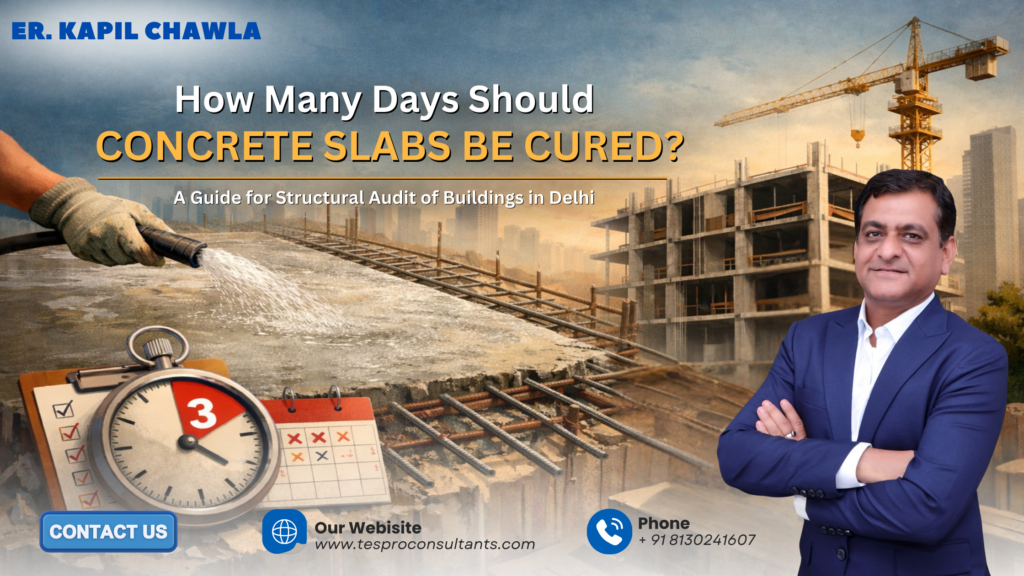
How Many Days Should Concrete Slabs Be Cured? A Guide for Structural Audit of Buildings in Delhi

Concrete curing is one of the most important steps in slab construction. Yet, on many sites, curing is either reduced or stopped early — leading to cracks, dusting, and durability issues, which can later become serious concerns during a structural audit of buildings in Delhi, where engineers evaluate reinforced concrete durability. If you are a homeowner, contractor, or industrial warehouse owner, this guide explains the correct curing duration for RCC slabs and Trimix concrete flooring as per Indian standards. Proper curing is essential in RCC construction, and poor curing often becomes visible during the structural assessment of existing buildings. What Is the Minimum Curing Period for Concrete Slabs? As per IS 456 issued by the Bureau of Indian Standards, the minimum curing duration depends on the cement type, which directly affects concrete strength estimation during engineering evaluations. Minimum curing period: 7 days Minimum curing period: 10 days Blended cement requires longer curing because hydration is slower, which plays an important role in maintaining reinforced cement concrete performance and long-term durability. Recommended Curing Duration (Best Practice in Indian Conditions) Due to high temperatures and rapid moisture loss in India, the recommended curing period for slabs is longer than the minimum code requirement, which is often highlighted during a structural audit of buildings in Delhi when experts review slab performance. Type of Slab Recommended Curing Duration Residential RCC Slab 10 days Roof Slab (Sun Exposed) 10–14 days Industrial Floor Slab 14 days Water Tank Slab 14 days minimum Trimix Flooring 14 days strongly recommended Concrete continues gaining strength for 28 days and beyond — but only if adequate moisture is maintained, which improves reinforced concrete durability in long-term structural performance. Curing for Trimix Concrete Flooring (Industrial Slabs) Trimix flooring is widely used in industrial RCC construction projects, such as: Since Trimix involves mechanical vibration and surface finishing, the top surface becomes dense and smooth — but also highly vulnerable to early moisture loss, which can later be identified during the structural assessment of existing buildings. Why Proper Curing Is Critical for Trimix Floors: Common Problems Due to Poor Curing: Best Practice for Trimix Curing: These practices help maintain proper reinforced cement concrete strength and durability. Why Concrete Slabs Need Longer Curing Slabs are more exposed compared to beams and columns because: Improper curing reduces durability even if cube strength appears satisfactory, which is why engineers carefully study curing history during concrete strength estimation and structural audit of buildings in Delhi. Final Recommendation Minimum curing is not equal to ideal curing. For long-term performance, crack control, and durability — especially in Indian climate conditions — 10–14 days curing for slabs and 14 days for Trimix flooring is strongly recommended. Proper curing significantly improves reinforced concrete durability, which is often evaluated during a structural audit of buildings in Delhi. Proper curing ensures: If you are planning: Or require a structural audit of buildings in Delhi to check safety, durability, and structural assessment of existing buildings, feel free to connect for professional guidance. Explore more: If planning to build your dream home?Check out Eternal Foundations—a helpful guide to building a strong, safe home that lasts for generations.📩 For a free e-book, email me at kapil.chawla@tesproconsultants.com
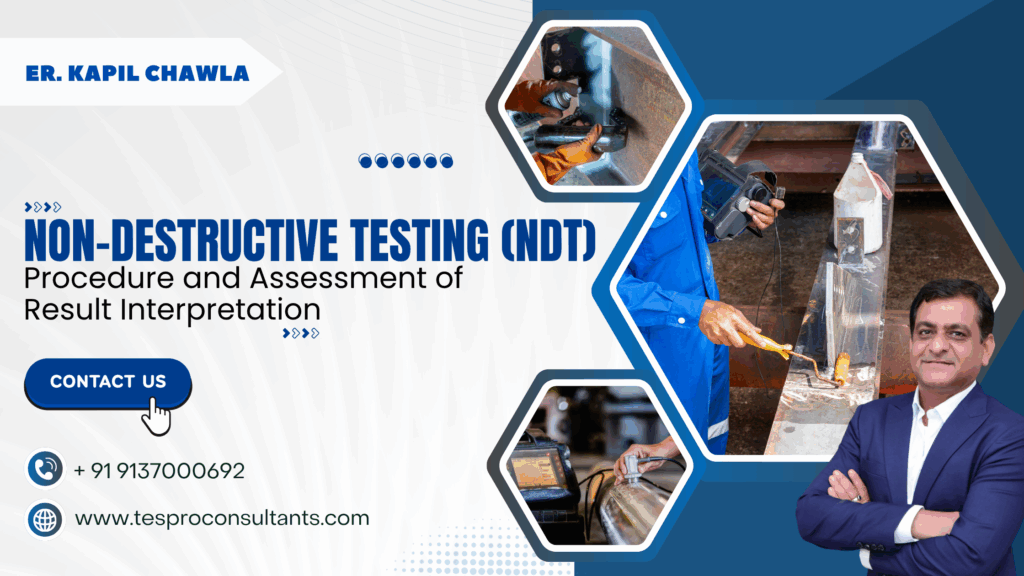
Non-Destructive Testing (NDT) Procedure and Assessment of Result Interpretation

In the realm of civil and structural engineering, assessing the health of an existing structure without causing damage is both an art and a science. Over time, structures are subjected to environmental exposure, material deterioration, overloading, and poor maintenance—all of which can affect their performance and safety. Non-Destructive Testing (NDT) has emerged as a reliable and scientific method for evaluating the in-situ condition of concrete and reinforcement without harming the structure. These techniques provide vital insights into the material quality, strength, and integrity, helping engineers make informed decisions about rehabilitation, retrofitting, or continued service. Unlike destructive testing methods that require physical removal of samples, NDT preserves the structural integrity while delivering meaningful diagnostic data—making it indispensable in modern structural assessment practices and structural health monitoring. Why Non-Destructive Testing? The primary objective of NDT in concrete is to evaluate the strength, durability, and internal soundness of a structure while keeping it operational. The key benefits include: NDT forms the foundation of any RCC building evaluation, particularly for aging buildings, bridges, industrial structures, and heritage properties. Common Non-Destructive Testing Methods in Civil Structures 1. Rebound Hammer Test (IS 13311 – Part 2) The Rebound Hammer Test, also known as the Schmidt Hammer Test, is one of the most widely used methods to assess the surface hardness and indirectly concrete strength estimation. Limitations:Results are influenced by surface conditions, carbonation, and aggregate type. Hence, the test should be supplemented with core testing or UPV for reliable estimation. 2. Ultrasonic Pulse Velocity (UPV) Test (IS 13311 – Part 1) The UPV test evaluates the quality and homogeneity of concrete by measuring the velocity of ultrasonic waves passing through it. When combined with rebound hammer data, UPV allows a more accurate correlation-based estimation of compressive strength. 3. Half-Cell Potential Test (ASTM C876) This electrochemical method assesses the probability of corrosion in embedded reinforcement. Note: The test indicates the likelihood of corrosion, not the corrosion rate. 4. Carbonation Depth Test The carbonation test reduces the alkalinity of concrete, breaking down the natural protective layer around reinforcement bars. If the carbonation depth exceeds the cover, corrosion is likely to initiate. 5. Cover Meter Survey The cover meter (or rebar locator) uses electromagnetic induction to determine reinforcement cover, bar size, and spacing. 6. Core Extraction and Testing (IS 516) While technically semi-destructive, core extraction remains the most reliable method for determining actual in-situ compressive strength. Step-by-Step NDT Procedure 1. Planning and Layout 2. Surface Preparation 3. Conducting Tests 4. Data Correlation and Analysis 5. Validation Interpretation of Results Interpreting NDT results requires engineering judgment and data correlation. No single test can represent the full picture; the combination of results provides the most reliable assessment. Test Parameter Typical Range / Interpretation Rebound Number >30: Good, 20–30: Fair, <20: Poor UPV (km/s) >4.5: Excellent, 3.5–4.5: Good, 3.0–3.5: Medium, <3.0: Doubtful Half-Cell Potential (mV) < -200: Low corrosion risk, -200 to -350: Uncertain, > -350: High corrosion risk Carbonation Depth Should be less than cover thickness While these indicative ranges help, contextual interpretation—considering structure age, environmental exposure, and loading—is vital. Reporting and Recommendations A professional NDT report should include the following: The report should present conclusions in clear engineering language, emphasising observed distress, likely causes, and the structure’s current load-carrying capacity. Conclusion Non-Destructive Testing is not merely a set of field procedures—it’s a diagnostic framework for making engineering decisions. When interpreted with experience and judgment, NDT results provide invaluable insights into material behaviour, durability, and safety. For consultants, contractors, and asset owners, NDT forms the foundation for cost-effective rehabilitation planning, risk mitigation, and lifecycle extension of critical structures. As structures age, proactive evaluation through NDT ensures that we don’t just build safely but sustain safely through effective structural health monitoring and precise concrete strength estimation. Explore more: If planning to build your dream home?Check out Eternal Foundations—a helpful guide to building a strong, safe home that lasts for generations.📩 For a free e-book, email me at kapil.chawla@tesproconsultants.com