tespro consultants

admin

Why Periodic Structural Testing Is Necessary for an Existing Building: Structural Audit of Buildings in Gurugram

Buildings are designed with a specific life expectancy and load assumptions. However, real-life conditions rarely remain exactly as assumed during the design stage. Over time, materials deteriorate, usage patterns change, and environmental factors take their toll. This is why periodic structural testing is not just recommended — it is essential for ensuring safety, serviceability, and long-term performance of an existing building through proper structural audit of buildings in Gurugram and professional building inspection services. As a structural professional, you already understand that structural failure rarely happens suddenly without warning. The warning signs are there — if we test and observe them in time with proper structural health assessment and regular structural audit of buildings in Gurugram. 1. Ageing and Material Deterioration All construction materials degrade with time: Even high-quality construction cannot stop natural ageing. Periodic structural testing helps: Without testing, deterioration remains hidden until it becomes dangerous. This is why structural testing methods and regular structural audit of buildings in Gurugram are essential for ageing structures. 2. Change in Usage or Load Conditions Many buildings are modified after construction: If the new loads exceed original design assumptions, the structure may become overstressed. Periodic structural audits and load reassessment ensure that: This process becomes more effective when guided by a qualified structural engineer in Gurugram and supported by a professional structural audit of buildings in Gurugram. 3. Environmental and Seismic Effects Environmental exposure plays a major role in structural health: Even in areas governed by standards such as IS 1893, buildings may experience micro-damage after small earthquakes that are not visible externally. Periodic testing helps detect: Proper structural stability certificate documentation and regular structural audit of buildings in Gurugram help identify such risks early. 4. Safety of Occupants The primary objective of structural testing is life safety. Small structural defects, if ignored, can escalate into: Regular inspection and testing reduce the risk of catastrophic failure and protect: A structurally sound building builds confidence and trust, especially when verified through structural health assessment and periodic structural audit of buildings in Gurugram. 5. Legal and Compliance Requirements Many municipal authorities and development control regulations require structural audits for buildings after a certain age (often 15–30 years, depending on the region). Periodic testing helps: A certified structural stability report increases the credibility and value of the property. Obtaining a structural stability certificate through proper building inspection services and structural audit of buildings in Gurugram ensures legal compliance. 6. Cost Savings in the Long Run Preventive maintenance is always cheaper than emergency repairs. Early detection through testing allows: Ignoring testing can lead to: Periodic testing is an investment, not an expense, especially when guided by reliable structural testing methods and a timely structural audit of buildings in Gurugram. 7. Increased Service Life of the Building Every building has a designed life (typically 50–100 years). However, with proper monitoring and maintenance, the service life can be extended significantly. Structural testing helps: A building that is monitored performs better and lasts longer with regular building inspection services and expert supervision from a structural engineer in Gurugram. 8. Data-Driven Maintenance Planning Modern structural assessment is not based on guesswork. It involves: Periodic testing provides measurable data, enabling engineers to: These data-driven decisions become more reliable through structural health assessment and continuous structural audit of buildings in Gurugram. Conclusion Periodic structural testing of existing buildings is not optional — it is a responsibility. It ensures: A building may appear visually fine, but structural health cannot be judged by appearance alone. Regular professional evaluation is the only reliable way to ensure that the structure continues to perform as intended, supported by a proper structural stability certificate and regular structural audit of buildings in Gurugram. For property owners, facility managers, and developers, periodic structural testing is the smartest step toward sustainable and safe infrastructure with professionanl building inspection services. Explore more: If planning to build your dream home?Check out Eternal Foundations—a helpful guide to building a strong, safe home that lasts for generations.📩 For a free e-book, email me at kapil.chawla@tesproconsultants.com
Structural Design vs Cost Cutting: Finding the Right Balance for Safe & Sustainable Buildings

In today’s competitive construction environment, cost-cutting often becomes a primary focus. While controlling project budgets is important, confusing cost-cutting with efficient structural design can lead to serious consequences—from safety risks to long-term financial losses. Understanding the difference between the two is critical for developers, builders, and homeowners alike, especially when considering cost optimization in construction strategies. What Is Structural Design? Structural design is the engineering process of creating a safe, durable, and efficient load-resisting system for a building. Proper structural design building planning ensure stability and performance throughout its lifecycle. It considers: A well-designed structure is not about over-design or under-design—it is about right structure design. What Is Cost Cutting in Construction? Cost-cutting typically involves reducing upfront expenses, often by ignoring proper structural design optimization principles and instead: While this may show immediate savings on paper, it often leads to hidden and recurring costs later, especially when structural safety assessment is overlooked. Structural Design Is Not Cost-Cutting—It Is Cost Optimization A common misconception is that a “cheaper structure” is a “better structure.” In reality, true structure design focuses on engineering accuracy and long-term efficiency. Structural Design Cost Cutting Based on engineering calculations Based on assumptions Optimizes material usage Reduces material blindly Ensures safety & code compliance Often compromises safety Low maintenance over lifecycle High repair & retrofitting costs Long-term value Short-term savings Good structure design actually saves money—not by reducing safety, but by eliminating inefficiencies through proper structural safety assessment and planning. The Hidden Cost of Poor Design Decisions When cost-cutting overrides structural logic and ignores professional structure design practices, projects may face: In seismic zones or industrial structures, such compromises can be catastrophic if structural design codes are not properly followed. Smart Structural Design: Where Savings Truly Come From Experienced structural engineers achieve economy through effective structural design optimization, including: These measures often reduce steel and concrete quantities naturally, supporting cost optimization in construction without risking performance. A Strong Structure Is an Investment, Not an Expense A building stands for decades. Saving a small percentage during construction by weakening structural intent instead of investing in proper structure design can result in multiple times the cost in repairs, retrofits, and downtime later. The cheapest structure is often the most expensive one in the long run, especially when structural design building fundamentals are ignored. Final Thoughts Structure design and cost-cutting are not opposing concepts, but they must be clearly distinguished. Choosing the right structural engineer ensures your project is economical, safe, and future-ready—backed by proper structural safety assessment and compliance with structural design codes. If you’re planning a new project or reviewing an existing structure, invest in proper structure design—not shortcuts. A strong structure design today ensures peace of mind and savings tomorrow. Need help with value engineering, structural audits, or optimized designs? Let’s build smart, safe, and sustainable with the right structure design approach. Explore more: If planning to build your dream home?Check out Eternal Foundations—a helpful guide to building a strong, safe home that lasts for generations.📩 For a free e-book, email me at kapil.chawla@tesproconsultants.com
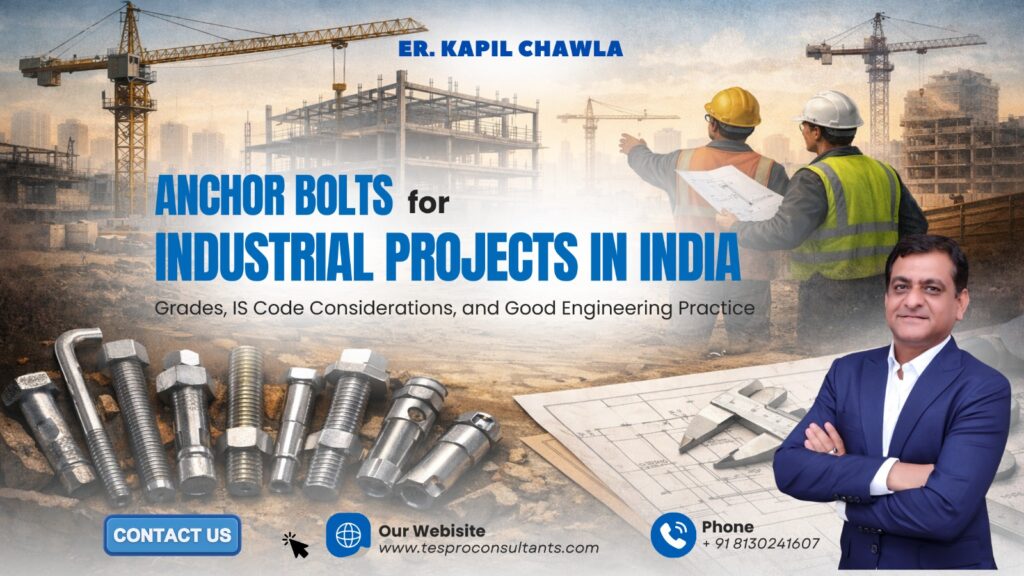
Anchor Bolts for Industrial Projects in India Grades, IS Code Considerations, and Good Engineering Practice

In industrial structures, anchor bolts for industrial projects in India are critical structural components that transfer loads safely from steel structures, machinery, and equipment into RCC foundations and slabs. Failures related to anchor bolts are often not due to steel strength alone, but due to incorrect grade selection, poor detailing, or improper installation. This article explains the anchor bolt grades commonly used in Indian industrial projects, along with IS code–aligned recommendations and practical guidance. Role of Anchor Bolts in Industrial Structures Anchor bolts are used to: Their performance depends on: Relevant IS Codes (Indian Context) While there is no single IS code for anchor bolts design, the following codes govern their application: Design practices in India are generally aligned with recommendations accepted by the Bureau of Indian Standards. Common Anchor Bolt Grades Used in Industrial Projects Grade 8.8 anchor bolts are the most widely used in industrial projects in India. Typical applications:Steel columns and base plates Why Grade 8.8 is preferred: Mechanical properties (approx.): 👉 As per good engineering practice, Grade 8.8 is structurally adequate for most industrial anchoring requirements. 2. Grade 10.9 – For Heavy Loads and Dynamic Conditions Grade 10.9 anchor bolts are used where higher stresses or dynamic effects are expected. Typical applications: Key considerations: 👉 Recommended only where design forces justify the higher grade. 3. Grades 5.8 / 6.8 – Limited Structural Use Lower-grade anchor bolts are generally restricted to non-critical applications. Typical applications: Not recommended for primary load-bearing industrial structures. Chemical vs Cast-in Anchor Bolts (Industrial Practice) Cast-in Anchor Bolts Chemical / Post-Installed Anchors Both systems must satisfy load, edge distance, spacing, and concrete strength requirements. Typical Recommendation for Industrial Projects Application Recommended Grade Steel columns & base plates Grade 8.8 PEB structures Grade 8.8 Heavy machinery & vibration Grade 10.9 Secondary / non-structural Grade 5.8 / 6.8 Professional Engineering Recommendation For most industrial projects in India, anchor bolts of minimum Grade 8.8 are structurally adequate when designed and installed as per IS code principles. Grade 10.9 anchor bolts should be adopted only where higher loads, vibration, or dynamic effects are involved. Key Takeaway The performance of anchor bolts is governed not only by steel grade, but equally by: A well-designed Grade 8.8 anchor bolt system, properly detailed and executed, will outperform a poorly installed higher-grade bolt. Need Help? If you are working on industrial sheds, factories, STP structures, or machinery foundations, proper anchor bolt design can significantly improve safety and service life. Explore more: If planning to build your dream home?Check out Eternal Foundations—a helpful guide to building a strong, safe home that lasts for generations.📩 For a free e-book, email me at kapil.chawla@tesproconsultants.com
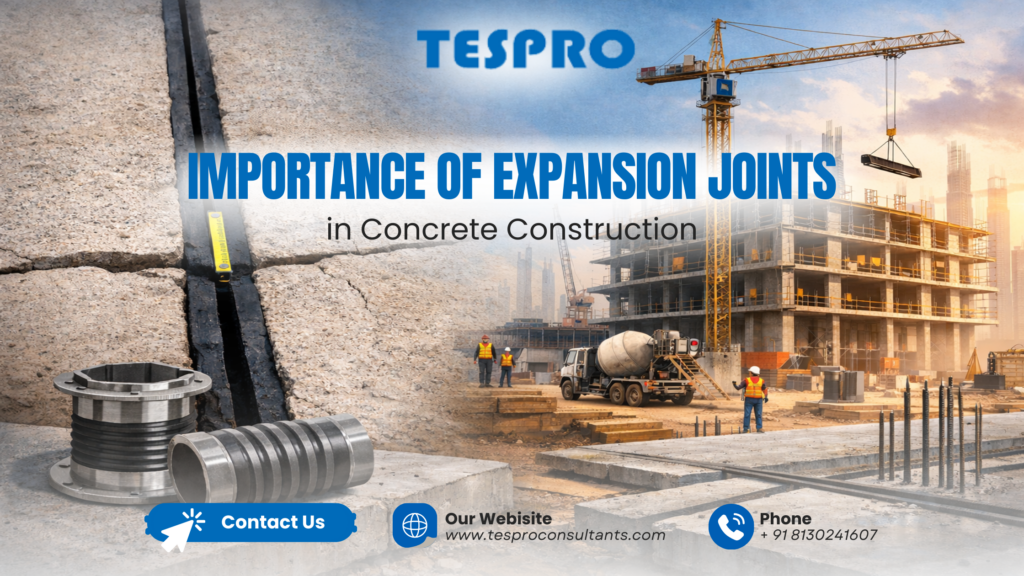
Importance of Expansion Joints in Concrete Construction

Expansion joints in concrete construction play a vital role in controlling cracks, accommodating movement, and improving the durability of structures. Concrete may appear rigid, but it undergoes continuous expansion and contraction due to temperature variation, shrinkage, creep, and loading effects. Without proper expansion joints, these movements generate internal stresses that lead to cracking, leakage, corrosion, and premature structural damage. This blog explains the importance of joints in concrete construction, their types, IS codal recommendations, and site best practices. What Are Expansion Joints in Concrete? Expansion joints are intentional gaps or separations provided in concrete structures to safely accommodate: These joints allow controlled movement and prevent random cracking. Why Are Expansion Joints Important in Concrete Construction? Concrete expands in hot weather and contracts in cold weather. Expansion joints provide a predetermined location for movement, preventing uncontrolled cracks. Cracks allow water and chemicals to enter concrete, causing reinforcement corrosion. Proper expansion joints reduce: Buildings without expansion joints often require expensive repairs within a few years. Correct joint detailing significantly extends service life. Expansion joints are critical in: Proper planning of joints in concrete construction ensures these structures remain durable and functional. Types of Joints Used in Concrete Structures Each joint type serves a distinct structural purpose. This section clearly explains types of joints in concrete. IS Codal Recommendations for Expansion Joints in Concrete Structures Joint spacing is indicative. Final design shall always be done by a Structural Engineer as per site conditions and exposure. Structure Type Relevant Indian Code Typical Expansion Joint Spacing Key Notes RCC Buildings (Residential / Commercial) IS 456:2000, IS 3414 30–45 m Mandatory for long buildings and irregular layouts. Follows RCC expansion joints guidelines Industrial Buildings & Large Floor Plates IS 456, IS 3414 25–30 m Control joints required at closer spacing Bridges & Flyovers IRC:6, IRC:83, IRC SP:69 As per movement calculation Expansion joints are mandatory Concrete Roads & Pavements IRC:58 30–45 m Contraction joints at 3.5–5 m Water Retaining Structures (Tanks, Reservoirs) IS 3370 As per dimensions PVC / rubber water stops required Retaining Walls & Basements IS 456, IS 3370 Based on wall length Waterproofing continuity is critical IS 456 emphasizes that adequate joints must be provided to relieve temperature and shrinkage stresses, which is a key principle of IS 456 expansion joints. The recommended expansion joint spacing as per IS code should always be followed. Common Site Mistakes Related to Expansion Joints Expansion joints must always remain free to expand and contract. Importance of expansion joints in buildings are critical for structural safety. Best Practices for Expansion Joints on Site Following these measures ensures correct joints in concrete construction and avoids future structural problems. Conclusion Expansion joints in concrete construction are not optional details—they are essential design and durability features. Properly planned and executed expansion joints: Concrete will move. Good engineering ensures it moves safely, which is the essence of joints in concrete construction.

How Structural Health Assessment Helps Extend the Life of Buildings

Buildings are long-term assets. Whether residential, commercial, or industrial, their safety and performance depend not only on good design and construction but also on timely evaluation and maintenance. One of the most effective tools to achieve this is a Structural Health Assessment. A proper structural health assessment ensures that hidden risks are identified before they become serious threats. Structural failures rarely occur suddenly. In most cases, buildings show early warning signs—cracks, corrosion, deflections, seepage, or changes in load usage—that go unnoticed or ignored. Structural Health Assessment helps identify these issues at an early stage, allowing corrective action before damage becomes critical or irreversible, ensuring overall structural safety assessment. What Is Structural Health Assessment? Structural Health Assessment is a systematic evaluation of an existing structure to determine its current condition, load-carrying capacity, durability, and remaining service life. It is an essential part of the structural assessment of existing buildings and combines: The objective is not only to assess safety but also to optimize repair, strengthening, and maintenance strategies through proper non destructive testing methods. Why Buildings Deteriorate Over Time All buildings are subjected to gradual deterioration due to multiple factors, which is why a structural audit of buildings becomes necessary: Without periodic Structural Health Assessment, these issues accumulate silently, reducing the building’s effective lifespan. How Structural Health Assessment Extends Building Life 1. Early Detection of Hidden Defects Non-destructive tests help identify internal issues such as low concrete strength, voids, honeycombing, corrosion, and cracks that are not visible externally. Early detection through structural health assessment allows targeted repairs instead of large-scale rehabilitation later. 2. Prevention of Progressive Damage Minor defects left unattended often lead to major failures. For example, corrosion starts locally but gradually spreads, weakening the entire structural system. Structural Health Assessment helps arrest deterioration at an early stage, preventing progressive damage and supporting long-term structural safety assessment. 3. Optimized Repair and Retrofitting Instead of blanket repairs, Structural Health Assessment enables engineering-based solutions—repairing only what is required and strengthening only critical elements. This reduces unnecessary expenditure and improves the effectiveness of interventions in the structural assessment of existing buildings. 4. Validation of Structural Capacity Many older buildings were designed for loads much lower than present-day requirements. Structural assessment verifies whether the structure can safely support: If deficiencies are identified through a structural audit of buildings, retrofitting measures can be implemented to safely extend usability. 5. Improved Safety and Compliance Regular assessments ensure that buildings meet acceptable safety standards and comply with statutory requirements. This is especially important for housing societies, commercial complexes, hospitals, schools, and industrial buildings, where structural safety assessment plays a critical role. 6. Cost Savings Over the Building Lifecycle Preventive assessment is significantly more economical than emergency repairs or reconstruction. Timely Structural Health Assessment: This makes structural health assessment a proactive and financially wise decision. 7. Extension of Service Life With proper assessment, maintenance, and strengthening through Structural Health Assessment, buildings can safely perform 20–30 years beyond their originally assumed service life. This sustainability benefit reduces the need for new construction and conserves resources. When Should Structural Health Assessment Be Conducted? Structural Health Assessment is recommended: It forms a critical part of the long-term structural audit of buildings. Conclusion Structural Health Assessment is not an expense—it is a strategic investment in safety, durability, and sustainability. By identifying problems early, validating structural capacity, and guiding effective repairs, it plays a critical role in extending the life of buildings and safeguarding occupants. In an era where aging infrastructure is a growing concern, periodic structural health assessment should be treated as an essential part of responsible building ownership and management. Explore more: If planning to build your dream home?Check out Eternal Foundations—a helpful guide to building a strong, safe home that lasts for generations.📩 For a free e-book, email me at kapil.chawla@tesproconsultants.com

Periodic Structural Health Assessment (SHA) in India: Current Scenario, Challenges, and the Way Forward

India’s built environment is at a critical juncture. While new construction continues at an unprecedented pace, a vast portion of existing buildings and infrastructure is steadily ageing. Residential societies, commercial complexes, hospitals, factories, and public buildings constructed decades ago are now operating far beyond their originally envisioned service conditions. In this context, Periodic Structural Health Assessment (SHA) has emerged as a vital tool to ensure safety, durability, and sustainability—but its adoption in India remains uneven and largely reactive. Understanding Structural Health Assessment Structural Health Assessment is a systematic evaluation of a structure’s current condition, load-carrying capacity, and remaining service life. It combines visual inspections, non destructive testing (NDT), selective destructive testing, and structural analysis to identify distress mechanisms such as cracking, corrosion, material degradation, overloading, or foundation issues. Unlike one-time inspections carried out after damage becomes visible, periodic SHA is preventive in nature. It enables stakeholders to detect early-stage problems, plan maintenance, and avoid sudden failures or expensive emergency repairs. Ageing Infrastructure: The Indian Reality A large percentage of buildings in Indian cities are 30–60 years old, particularly in metro regions. Many of these structures were designed: Over time, environmental exposure—humidity, pollution, salinity in coastal areas, and temperature variations—accelerates deterioration. Yet, routine health checks of buildings, including a building safety inspection, are still not a standard practice across the country. Regulatory Scenario in India India does not yet have a uniform national mandate requiring periodic SHA for all buildings. Some municipal corporations, especially in large cities, have introduced compulsory structural audit of buildings above a certain age. However, enforcement and technical depth vary widely. National codes published by the Bureau of Indian Standards guide durability, maintenance, and safety evaluation, but these are often treated as recommendations rather than enforceable requirements for existing structures. As a result, SHA is frequently carried out only when: Typical Triggers for SHA in India In practical terms, most SHAs in India are initiated due to: Preventive, scheduled assessments—similar to annual medical check-ups—are still rare, particularly in private residential buildings. Key Components of SHA in the Indian Context A comprehensive structural health assessment typically includes: In some cases, a structural stability certificate may also be issued following a detailed assessment. Challenges Limiting Effective SHA Adoption Despite growing awareness, several challenges persist: Changing Trends and Growing Importance The scenario is gradually evolving. Increased reporting of building failures, growing litigation, and awareness among housing societies are pushing SHA into focus. Infrastructure projects—metros, bridges, highways, and public utilities—are now routinely subjected to periodic health monitoring. Additionally, sustainability goals and life-cycle cost optimization are driving asset owners to recognize that maintaining existing structures is often more economical and environmentally responsible than demolition and reconstruction. The Way Forward for India For Structural Health Assessment to become an integral part of India’s construction ecosystem: Conclusion In India, Structural Health Assessment is transitioning from an optional exercise to a critical necessity. As cities grow denser and buildings age, safety can no longer depend on visual judgment alone. Periodic SHA provides the technical insight needed to protect lives, preserve assets, and ensure sustainable urban development. Strong structures are not just designed and built—they are continuously assessed and responsibly maintained. Explore more: If planning to build your dream home?Check out Eternal Foundations—a helpful guide to building a strong, safe home that lasts for generations.📩 For a free e-book, email me at kapil.chawla@tesproconsultants.com
What Fire Does to RCC (Reinforced Cement Concrete): A Structural Engineer’s Assessment

When an RCC building (Reinforced Cement Concrete) undergoes fire, the visible damage may appear limited to soot, cracks, or plaster peeling. However, fire causes irreversible changes to concrete and reinforcement steel, which directly affect the strength, stability, and service life of the structure. Understanding the fire damage to RCC is critical in evaluating long-term safety. From a structural engineer’s perspective, any RCC structure made of Reinforced Cement Concrete exposed to fire for more than a short duration must undergo proper building inspection services before being declared safe. How RCC Behaves During a Fire Reinforced Cement Concrete is a composite material made of: During a fire, both materials react differently to high temperatures, leading to internal distress. This distress significantly impacts the performance of Reinforced Cement Concrete, especially in cases of severe fire damaged buildings. Effect of Fire on Concrete The fire effect on concrete plays a major role in the structural deterioration of Reinforced Cement Concrete members. 1. Loss of Compressive Strength Concrete begins to lose strength at relatively low temperatures: Temperature Impact on Concrete 100–200°C Microcracking begins 300°C Noticeable strength loss 600°C 40–50% strength reduction 800°C+ Concrete becomes brittle and unsafe Even if the member looks intact, the load-carrying capacity of the Reinforced Cement Concrete element is significantly reduced, often requiring fire damage restoration planning. 2. Cracking and Spalling of Concrete Cover Fire causes: Spalling exposes reinforcement steel, accelerating corrosion and reducing fire resistance further. Such fire damage to RCC can severely weaken Reinforced Cement Concrete structures. 3. Change in Concrete Colour (Key Visual Indicator) Colour change helps engineers identify fire severity in Reinforced Cement Concrete structures: These indicators guide testing locations and repair decisions during post fire structural inspection. Effect of Fire on Reinforcement Steel Steel in Reinforced Cement Concrete is highly sensitive to temperature rise: This results in: In many fire damaged buildings, reinforcement deterioration is more critical than surface concrete damage. Loss of Bond Between Steel and Concrete The bond between concrete and reinforcement is critical for Reinforced Cement Concrete performance. Fire leads to: Even without visible bar damage, bond failure alone can make the structure unsafe, which is why building inspection services are essential after fire incidents. RCC Structural Members Most Affected by Fire Structural Element Fire Risk Level Reason Slabs Very High Thin sections heat up quickly Beams Very High Flexural failure risk Columns High Critical load-bearing members Staircases Very High Safety and evacuation concern These structural elements of Reinforced Cement Concrete structures require detailed evaluation after exposure to fire. Why Visual Inspection After Fire Is NOT Enough A common mistake is assuming: These assumptions are structurally dangerous, especially when evaluating fire effect on concrete. A proper post fire structural inspection of Reinforced Cement Concrete must include: Such an assessment is necessary for accurate fire damage restoration decisions. Fire Damaged RCC: Repair or Demolition? Fire-damaged Reinforced Cement Concrete can often be repaired, but only after engineering evaluation and building inspection services. Possible solutions include: Repair without assessment is unsafe and unscientific, particularly in heavily fire damaged buildings. What Should Be Done Immediately After a Fire? Step 1: Safety Measures Step 2: Structural Engineer Inspection Step 3: Decision Making Timely fire damage restoration planning ensures structural safety. Frequently Asked Questions Reinforced Cement Concrete has good fire resistance, but is not fireproof. Prolonged exposure causes serious strength loss and significant fire damage to RCC. Yes, only after a structural audit, detailed evaluation, and professional building inspection services. Depends on member size, cover thickness, and fire duration. Thin Reinforced Cement Concrete members fail faster. No. Plaster repair is cosmetic and does not restore the structural strength affected by the fire effect on concrete. Final Conclusion: Structural Engineer’s Advice Fire damage in Reinforced Cement Concrete is often hidden but always critical. Any RCC building exposed to fire must undergo a professional structural audit and post fire structural inspection before reuse. Decisions based on assumptions in fire damaged buildings can lead to progressive failure or sudden collapse in the future. Has your Reinforced Cement Concrete building undergone fire damage?Do not take risks. Consult a qualified structural engineer before re-occupying the building. Explore more: If planning to build your dream home?Check out Eternal Foundations—a helpful guide to building a strong, safe home that lasts for generations.📩 For a free e-book, email me at kapil.chawla@tesproconsultants.com
Admixtures for RCC: A Complete Guide to Reducing Setting Time and Boosting Early Strength

In fast-track construction projects, time efficiency without compromising structural safety is critical. One of the most effective technical solutions for improving early strength gain and reducing setting time in RCC (Reinforced Cement Concrete) is the use of admixtures for RCC. Because modern construction moves so quickly, waiting for concrete to harden can feel like forever. However, by using the right chemicals, builders can speed up the process safely. This article explains the technical aspects, applications, and precautions related to accelerating admixtures in concrete. What Are Accelerating Admixtures? Imagine adding a “fast-forward” button to your concrete mix. That is exactly what these chemicals do. Accelerating admixtures for RCC are special compounds added to the mix to help it harden faster. Specifically, they help to: Furthermore, these are especially useful in cold weather, precast works, and any project with a very tight deadline. Types of Admixtures Used for Reducing Setting Time 1. Calcium Chloride (Traditional Accelerator) In the past, Calcium Chloride was the go-to choice for rcc setting time reduction. Advantages: Limitation: For this reason, calcium chloride is usually not recommended for modern buildings, especially in reinforced or prestressed concrete. 2. Non-Chloride Accelerators (Recommended for RCC) When working with structural concrete admixtures, professionals prefer non-chloride-based options. These are much safer for the steel inside the pillars and beams. Common examples include: Advantages: Alternative Option: Rapid Hardening Cement Sometimes, people choose a special type of cement instead of adding chemicals. While it does work, there are some things to keep in mind: Therefore, using a liquid or powder admixture is usually more practical for most structural projects. Typical Dosage Finding the right balance is very important. Usually, the dosage of these admixtures ranges between 0.5% to 2% by weight of cement. However, the exact amount depends on: Consequently, a trial mix is always mandatory before using the chemical on the actual building site. Practical Applications These fast-acting chemicals are commonly used in: Site Precautions & Engineering Considerations Even though these tools are helpful, they must be used carefully. If someone uses too much, it can hurt the building later. Always follow these rules: If there are doubts about an existing structure, a structural audit consultant in Delhi can help check if the concrete is still healthy and strong. Structural Engineering Perspective From a design standpoint, speed should never come at the cost of safety. When planning a project, engineers look at the loading conditions and the environment. This ensures that the admixtures for RCC provide speed without causing cracks or weakening the structure over time. Are you planning a new project or fixing an old one? Getting a professional review is the best way to ensure your building stands strong for decades.Schedule your technical consultation and RCC mix review with Tespro Consultants today!

Different Types of Structures a Structural Engineer Can Design in India

India’s diverse geography, varying climate zones, and rapid urbanization demand a wide range of specialized engineering solutions. From high-rise buildings in metro cities to massive industrial plants, the expertise of structural engineers is essential to ensuring safety and longevity. The importance of structural design cannot be overstated; it is the backbone of any project, ensuring that every building can withstand natural forces. This blog highlights the major types of structures a structural engineer can design in India, along with their applications and key design considerations. 1. Residential Projects: Crafting Safe Homes for Indian Families Focus: Indian Home Construction & Residential Safety Residential buildings form a massive portion of the workload for a  structural engineer. Whether it is a luxury villa or a multi-story apartment, ensuring a safe structural design is the top priority to protect lives and investments. 2. Commercial Buildings: Building the Foundations of Modern Business Focus: Long Spans and Flexible Structural Design Commercial structures require flexible layouts and the ability to support higher live loads compared to standard Indian home construction. 3. Industrial Structures: Engineering Strength for Heavy Manufacturing Focus: Precision and Speed in Industrial Structural Design Industrial projects demand precision and heavy-load handling capacity. Structural engineers working in this sector often deal with specialized materials and fast-track construction methods like PEB. 4. Institutional Buildings: Designing Durable Spaces for the Public Focus: High-Density Safety and Structural Resilience These buildings are designed with a focus on public safety and a very long service life. structural engineers implement higher safety margins here to ensure these facilities remain functional during emergencies. 5. Infrastructure Projects: Connecting India Through Expert Engineering Focus: Transportation Networks and National Growth Infrastructure development is a primary driver of the construction industry. Structural engineers in this sector design the arteries of the nation, ensuring they can handle the heavy demands of a growing population. 6. Hydraulic Structures: Mastering Water Pressure and Containment Focus: Specialized Leak-Proof Structural Design Water structures require strict crack-control and specialized serviceability checks to prevent leakage and chemical corrosion over time. 7. Special Heavy Structures: Tackling Complex Engineering Horizons Focus: Advanced Analysis for Unique Structural Forms These structures involve complex loading patterns and advanced mathematical analysis. A structural engineer must use sophisticated software to model these unique, often slender builds against high wind speeds. 8. Retrofitting & Rehabilitation: Giving Old Buildings New Life Focus: Strengthening and Restoring Structural Integrity A structural engineer also works on existing buildings to extend their lifespan or upgrade their strength to meet modern safety standards. 9. Temporary Structures: Ensuring Safety During the Construction Phase Focus: Support Systems for Successful Project Completion Often overlooked, these structures are critical for site safety. Even during the initial stages of Indian home construction, temporary supports must be engineered to prevent accidents. Why Professional Engineering is the Key to Success A structural engineer in India works across a wide spectrum of projects, ensuring that every build—from a small house to a massive bridge—is resilient. Each structure type demands sound engineering judgment, strict code compliance, and an intimate understanding of local soil and climate conditions. With India’s growing focus on safety and smart infrastructure, the role of structural engineers continues to expand, making professional structural design one of the most impactful professions in the built environment today. Need Professional Structural Design Services? If you’re looking for a structural engineer for home construction or a large-scale industrial project, ensuring a safe structural design starts with the right partner.

Prerequisites Before Proceeding with a Building Structure Audit

A building structure audit is a critical exercise to assess the safety, serviceability, and remaining life of a structure. It provides insights into structural stability and helps plan building maintenance and repair effectively. However, the accuracy and usefulness of an audit largely depend on the pre-audit preparedness. Without proper inputs and planning, even a detailed audit may lead to incomplete or misleading conclusions. Outlined below are the key prerequisites that must be ensured before initiating a building structure audit. 1. Availability of Structural Drawings and Documents Before a site inspection, all relevant technical documents should be collected and reviewed, including These documents help the structural engineer understand the design intent, load path, and structural system. Proper documentation also guides decisions about concrete testing methods during the audit. 2. Basic Information of the Building Essential building details must be established prior to the audit: Changes in building usage often introduce loads beyond the original design capacity. Knowing these details helps in evaluating structural defects in buildings accurately. 3. Identification of Visible Distress A preliminary visual survey forms the foundation of any building structure audit. Key observations include: Identifying visible distress early guides the scope and location of further testing and helps plan corrective measures for building maintenance and repair. 4. Site Accessibility and Readiness The audit team must have safe and adequate access to all critical areas, such as: Restricted access can lead to incomplete assessment, potentially overlooking critical structural defects in buildings. 5. Utility and Safety Arrangements Proper site arrangements should be ensured before testing: Safety of personnel is a non-negotiable prerequisite. Additionally, proper setup ensures accurate implementation of concrete testing methods and other structural evaluations. 6. Clarity on Audit Scope The scope of the structure audit must be clearly defined at the outset: Clear scope avoids ambiguity and ensures the audit can support structural health monitoring efforts where needed. 7. Purpose and Client Expectations Understanding the objective of the audit is essential: Timeline, reporting format, and deliverables should be mutually agreed upon. A well-defined objective enhances the reliability of the building structure audit outcomes. Conclusion A building structure audit is not merely an inspection—it is a systematic engineering evaluation. Proper prerequisites ensure: By integrating concrete testing methods, detecting structural defects in buildings, and supporting structural health monitoring, a well-prepared audit leads to dependable insights for building maintenance and repair. A thorough building structure audit provides stakeholders with confidence in the safety and longevity of the structure.