
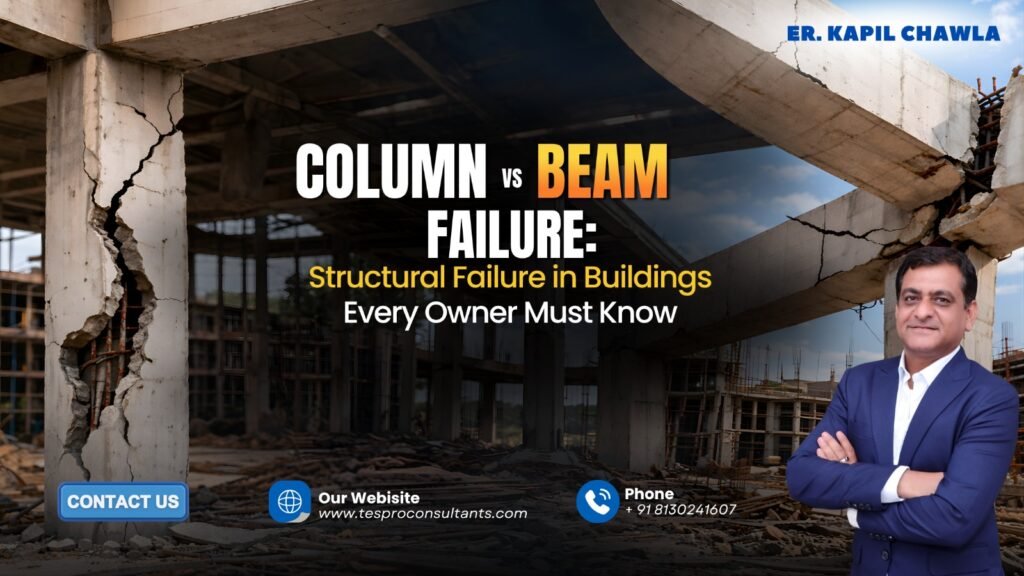
Every building stands safely only when its load-carrying parts work properly. Structural failure in buildings often starts when owners ignore small cracks, unusual deflection, or settlement signs. Columns and beams are the two most critical structural members, but their failure patterns are very different. Because of that, understanding these structural failure types helps owners take faster action before damage becomes dangerous. Also, proper beam and column design and timely structural analysis reduce risk, while early signs of structural failure support better decision-making. So, following practical building safety tips from experts can prevent major repair costs and protect lives.
Understanding Structural Elements: Column vs Beam
Columns and beams are the most important structural members, but they perform different roles in any building. So, knowing their function helps in better beam and column design and safety planning.
- Column
- Vertical structural member
- Transfers load directly to the foundation
- Works mainly in compression
- Failure can affect the entire structure
- Beam
- Horizontal structural member
- Supports slab and wall loads
- Works in bending and shear
- Transfers load to columns
Also, engineers classify different structural failure types based on how these elements respond under load conditions.
Column Failure: Types and Mechanisms
Column failure is highly critical because it can cause the sudden collapse of the structure, so understanding its behaviour is essential for understanding structural failure types.
- Compression Failure
- Concrete crushes under heavy axial load
- Mostly seen in short columns
- Buckling Failure
- Slender columns bend sideways
- Happens due to instability under load
- Axial + Bending Failure
- The load is applied eccentrically
- Creates a combined stress condition
- Shear Failure
- Sudden and brittle failure
- Common in seismic conditions
However, proper detailing, confinement, and accurate structural analysis can significantly reduce these risks and improve performance.
Beam Failure: Types and Mechanisms
Beam failure is generally less dangerous compared to column failure, but it still needs attention because it shows visible signs of structural failure before complete damage.
- Flexural Failure
- Cracks develop at the bottom due to tension
- Steel yields before failure (safe behaviour).
- Shear Failure
- Diagonal cracks near supports
- Sudden and brittle in nature
- Torsion Failure
- Occurs in irregular layouts
- Causes twisting of the beam
- Deflection Failure
- Excess bending over time
- Affects the usability of the structure
Moreover, proper reinforcement and good beam and column design ensure that beams behave in a controlled and predictable manner.
Key Differences: Column vs Beam Failure
Understanding the difference helps in planning better building safety tips and design strategies.
| Aspect | Beam Failure | Column Failure |
| Nature | Ductile (slow) | Brittle (sudden) |
| Warning | Visible cracks | Very few signs |
| Impact | Local damage | Total collapse |
| Design | Controlled failure | Must be very strong |
| Repair | Possible | Difficult |
Therefore, engineers always focus on avoiding structural failure in buildings by making columns stronger than beams.
Warning Signs of Beam and Column Failure
Early detection is possible if you observe the right signs of structural failure, so regular inspection is important to avoid structural failure in buildings.
- Beam Signs
- Cracks at mid-span
- Diagonal cracks near supports
- Excess deflection
- Column Signs
- Vertical cracks
- Concrete spalling
- Exposed steel bars
- Slight tilting
Also, following basic building safety tips, like avoiding extra load, can prevent major issues.
Testing and Inspection Methods
Testing helps in understanding the actual condition of the structure, so engineers use different methods for accurate structural analysis.
- Rebound Hammer Test
- Checks the surface strength of concrete
- Checks the surface strength of concrete
- UPV Test
- Detects internal cracks
- Detects internal cracks
- Core Test
- Measures actual concrete strength
- Measures actual concrete strength
- Half-Cell Potential
- Checks corrosion in steel
- Checks corrosion in steel
- Visual Inspection
- First step to identify damage
In addition, these tests help classify different structural failure types and plan repairs effectively.
Consult Er. Kapil Chawla from TESPRO Consultants for expert guidance, accurate inspections, and reliable structural solutions to avoid. Structural failure in buildings later. His experience ensures safe, strong, and long-lasting buildings for every project.
Explore more: If planning to build your dream home?
Check out Eternal Foundations—a helpful guide to building a strong, safe home that lasts for generations.📩 For a free e-book, email me at kapil.chawla@tesproconsultants.com