
Concrete curing is one of the most important steps in slab construction. Yet, on many sites, curing is either reduced or stopped early — leading to cracks, dusting, and durability issues, which can later become serious concerns during a structural audit of buildings in Delhi, where engineers evaluate reinforced concrete durability.
If you are a homeowner, contractor, or industrial warehouse owner, this guide explains the correct curing duration for RCC slabs and Trimix concrete flooring as per Indian standards. Proper curing is essential in RCC construction, and poor curing often becomes visible during the structural assessment of existing buildings.
What Is the Minimum Curing Period for Concrete Slabs?
As per IS 456 issued by the Bureau of Indian Standards, the minimum curing duration depends on the cement type, which directly affects concrete strength estimation during engineering evaluations.
- OPC (Ordinary Portland Cement)
Minimum curing period: 7 days
- PPC / PSC (Blended Cement)
Minimum curing period: 10 days
Blended cement requires longer curing because hydration is slower, which plays an important role in maintaining reinforced cement concrete performance and long-term durability.
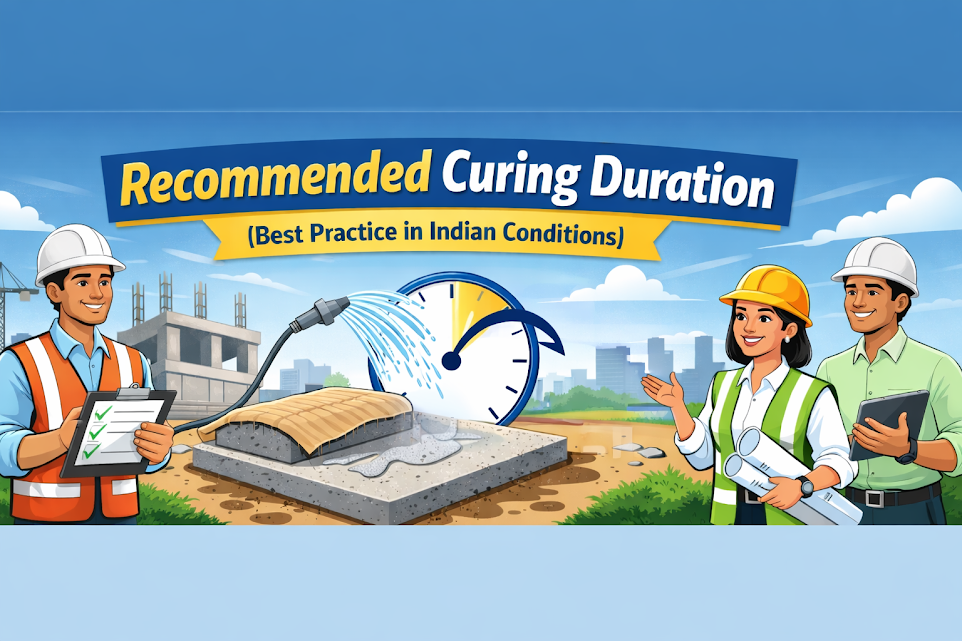
Recommended Curing Duration (Best Practice in Indian Conditions)
Due to high temperatures and rapid moisture loss in India, the recommended curing period for slabs is longer than the minimum code requirement, which is often highlighted during a structural audit of buildings in Delhi when experts review slab performance.
| Type of Slab | Recommended Curing Duration |
| Residential RCC Slab | 10 days |
| Roof Slab (Sun Exposed) | 10–14 days |
| Industrial Floor Slab | 14 days |
| Water Tank Slab | 14 days minimum |
| Trimix Flooring | 14 days strongly recommended |
Concrete continues gaining strength for 28 days and beyond — but only if adequate moisture is maintained, which improves reinforced concrete durability in long-term structural performance.
Curing for Trimix Concrete Flooring (Industrial Slabs)
Trimix flooring is widely used in industrial RCC construction projects, such as:
- Warehouses
- Industrial sheds
- Factories
- Logistics hubs
Since Trimix involves mechanical vibration and surface finishing, the top surface becomes dense and smooth — but also highly vulnerable to early moisture loss, which can later be identified during the structural assessment of existing buildings.
Why Proper Curing Is Critical for Trimix Floors:
- Large exposed surface area
- High shrinkage stress
- Heavy forklift traffic
- Abrasion resistance depends on hydration
Common Problems Due to Poor Curing:
- Surface dusting
- Plastic shrinkage cracks
- Reduced abrasion resistance
- Joint edge spalling
- Reduced floor load performance
Best Practice for Trimix Curing:
- Start curing within 6–8 hours after finishing
- Prefer the ponding method
- Maintain continuous curing for minimum 14 days
- Avoid early heavy loading
These practices help maintain proper reinforced cement concrete strength and durability.
Why Concrete Slabs Need Longer Curing
Slabs are more exposed compared to beams and columns because:
- Maximum surface exposure to sun and wind
- Rapid evaporation of water
- Higher shrinkage potential
- Direct load application
Improper curing reduces durability even if cube strength appears satisfactory, which is why engineers carefully study curing history during concrete strength estimation and structural audit of buildings in Delhi.
Final Recommendation
Minimum curing is not equal to ideal curing.
For long-term performance, crack control, and durability — especially in Indian climate conditions — 10–14 days curing for slabs and 14 days for Trimix flooring is strongly recommended. Proper curing significantly improves reinforced concrete durability, which is often evaluated during a structural audit of buildings in Delhi.
Proper curing ensures:
- Better strength gain
- Reduced cracking
- Improved abrasion resistance
- Longer service life
- Lower maintenance cost
If you are planning:
- RCC slab casting
- Warehouse Trimix flooring
- Structural audit of the existing floor
- Floor load certification
Or require a structural audit of buildings in Delhi to check safety, durability, and structural assessment of existing buildings, feel free to connect for professional guidance.
Explore more: If planning to build your dream home?
Check out Eternal Foundations—a helpful guide to building a strong, safe home that lasts for generations.📩 For a free e-book, email me at kapil.chawla@tesproconsultants.com