
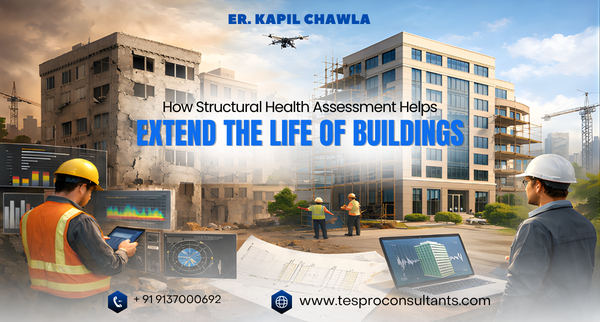
Buildings are long-term assets. Whether residential, commercial, or industrial, their safety and performance depend not only on good design and construction but also on timely evaluation and maintenance. One of the most effective tools to achieve this is a Structural Health Assessment. A proper structural health assessment ensures that hidden risks are identified before they become serious threats.
Structural failures rarely occur suddenly. In most cases, buildings show early warning signs—cracks, corrosion, deflections, seepage, or changes in load usage—that go unnoticed or ignored. Structural Health Assessment helps identify these issues at an early stage, allowing corrective action before damage becomes critical or irreversible, ensuring overall structural safety assessment.
What Is Structural Health Assessment?
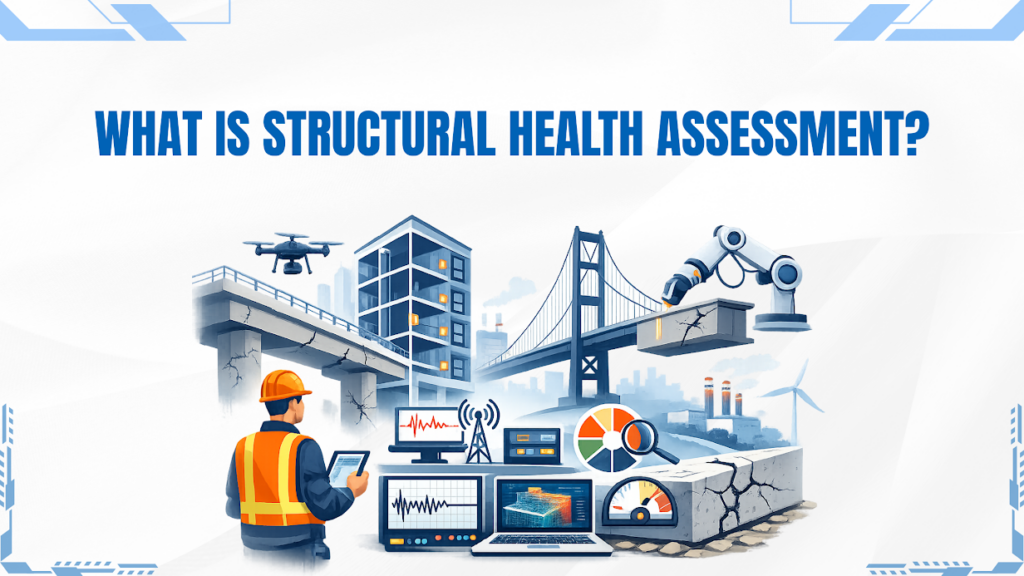
Structural Health Assessment is a systematic evaluation of an existing structure to determine its current condition, load-carrying capacity, durability, and remaining service life. It is an essential part of the structural assessment of existing buildings and combines:
- Visual inspection
- Review of design and construction documents
- Non-Destructive Testing (NDT)
- Material strength evaluation
- Structural analysis (where required)
The objective is not only to assess safety but also to optimize repair, strengthening, and maintenance strategies through proper non destructive testing methods.
Why Buildings Deteriorate Over Time
All buildings are subjected to gradual deterioration due to multiple factors, which is why a structural audit of buildings becomes necessary:
- Ageing of materials like concrete and steel
- Environmental exposure (humidity, chlorides, pollution)
- Corrosion of reinforcement
- Poor construction practices
- Change in usage or increase in loads
- Unauthorized modifications (wall removal, extra floors, heavy equipment)
Without periodic Structural Health Assessment, these issues accumulate silently, reducing the building’s effective lifespan.
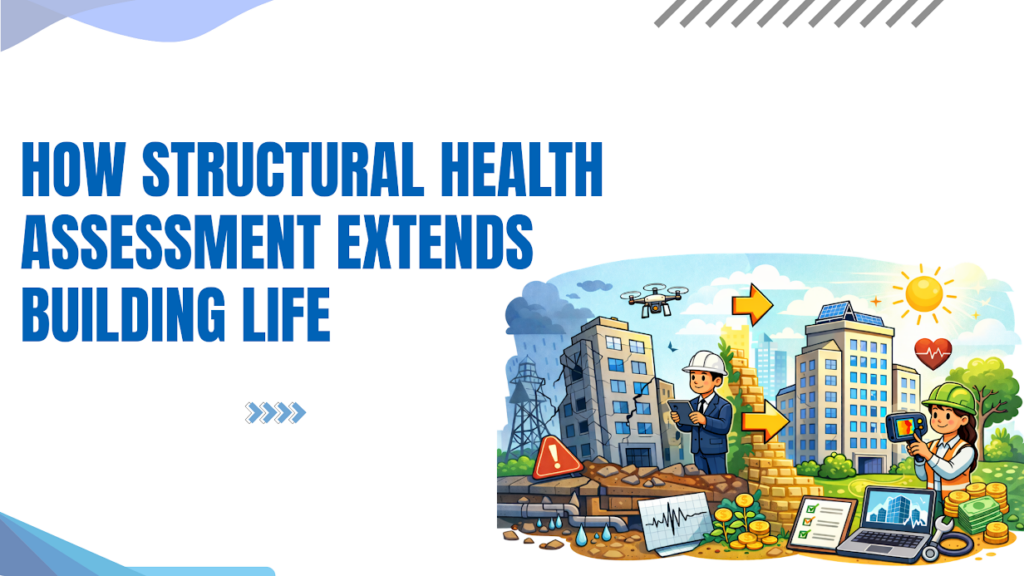
How Structural Health Assessment Extends Building Life
1. Early Detection of Hidden Defects
Non-destructive tests help identify internal issues such as low concrete strength, voids, honeycombing, corrosion, and cracks that are not visible externally. Early detection through structural health assessment allows targeted repairs instead of large-scale rehabilitation later.
2. Prevention of Progressive Damage
Minor defects left unattended often lead to major failures. For example, corrosion starts locally but gradually spreads, weakening the entire structural system. Structural Health Assessment helps arrest deterioration at an early stage, preventing progressive damage and supporting long-term structural safety assessment.
3. Optimized Repair and Retrofitting
Instead of blanket repairs, Structural Health Assessment enables engineering-based solutions—repairing only what is required and strengthening only critical elements. This reduces unnecessary expenditure and improves the effectiveness of interventions in the structural assessment of existing buildings.
4. Validation of Structural Capacity
Many older buildings were designed for loads much lower than present-day requirements. Structural assessment verifies whether the structure can safely support:
- Additional floors
- Change of occupancy
- New machinery or services
- Renovation or remodelling works
If deficiencies are identified through a structural audit of buildings, retrofitting measures can be implemented to safely extend usability.
5. Improved Safety and Compliance
Regular assessments ensure that buildings meet acceptable safety standards and comply with statutory requirements. This is especially important for housing societies, commercial complexes, hospitals, schools, and industrial buildings, where structural safety assessment plays a critical role.
6. Cost Savings Over the Building Lifecycle
Preventive assessment is significantly more economical than emergency repairs or reconstruction. Timely Structural Health Assessment:
- Reduces long-term maintenance costs
- Avoids sudden evacuation or demolition
- Protects property value and investment
This makes structural health assessment a proactive and financially wise decision.
7. Extension of Service Life
With proper assessment, maintenance, and strengthening through Structural Health Assessment, buildings can safely perform 20–30 years beyond their originally assumed service life. This sustainability benefit reduces the need for new construction and conserves resources.
When Should Structural Health Assessment Be Conducted?
Structural Health Assessment is recommended:
- For buildings older than 15–20 years
- Before major renovation or wall removal
- After events like earthquakes, fire, or flooding
- When visible distress (cracks, leakage, corrosion) appears
- Before a change in building usage or load pattern
It forms a critical part of the long-term structural audit of buildings.
Conclusion
Structural Health Assessment is not an expense—it is a strategic investment in safety, durability, and sustainability. By identifying problems early, validating structural capacity, and guiding effective repairs, it plays a critical role in extending the life of buildings and safeguarding occupants.
In an era where aging infrastructure is a growing concern, periodic structural health assessment should be treated as an essential part of responsible building ownership and management.
Explore more: If planning to build your dream home?
Check out Eternal Foundations—a helpful guide to building a strong, safe home that lasts for generations.📩 For a free e-book, email me at kapil.chawla@tesproconsultants.com