
In industrial structures, anchor bolts for industrial projects in India are critical structural components that transfer loads safely from steel structures, machinery, and equipment into RCC foundations and slabs. Failures related to anchor bolts are often not due to steel strength alone, but due to incorrect grade selection, poor detailing, or improper installation.
This article explains the anchor bolt grades commonly used in Indian industrial projects, along with IS code–aligned recommendations and practical guidance.
Role of Anchor Bolts in Industrial Structures
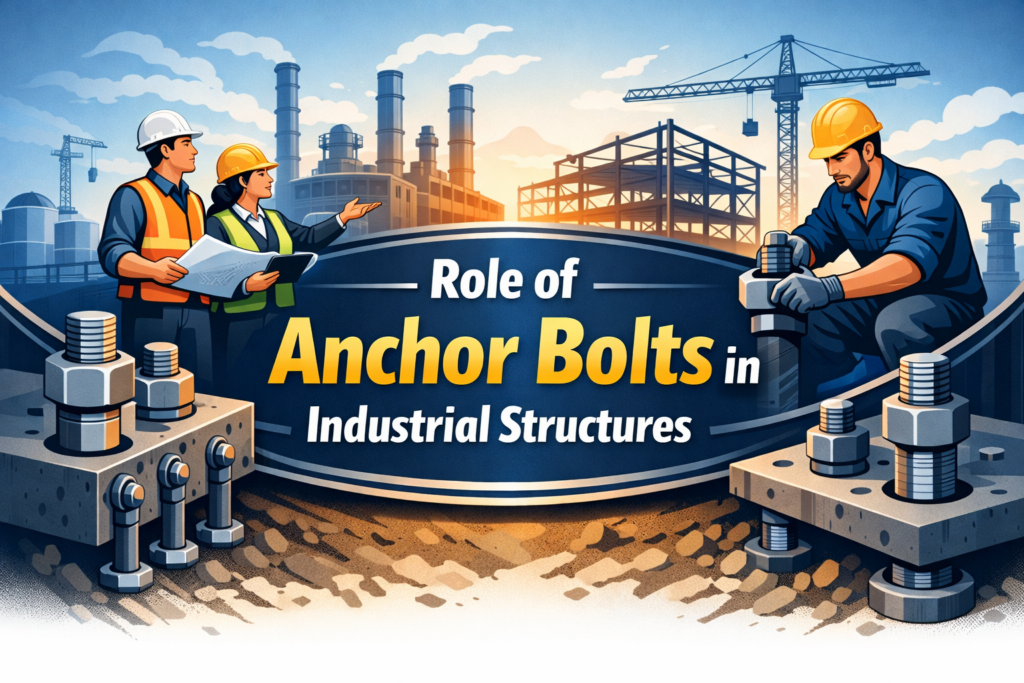
Anchor bolts are used to:
- Transfer axial forces, shear forces, and moments
- Anchor steel columns, base plates, machinery, and equipment
- Resist uplift, vibration, and dynamic loads
Their performance depends on:
- Bolt grade
- Concrete strength
- Embedment depth
- Edge distance and spacing
- Installation quality
Relevant IS Codes (Indian Context)
While there is no single IS code for anchor bolts design, the following codes govern their application:
- IS 800 – Design of Steel Structures
- IS 456 – Plain and Reinforced Concrete
- IS 1367 / IS 1364 – Mechanical properties of fasteners
Design philosophy follows limit state principles and internationally accepted anchorage concepts
Design practices in India are generally aligned with recommendations accepted by the Bureau of Indian Standards.
Common Anchor Bolt Grades Used in Industrial Projects
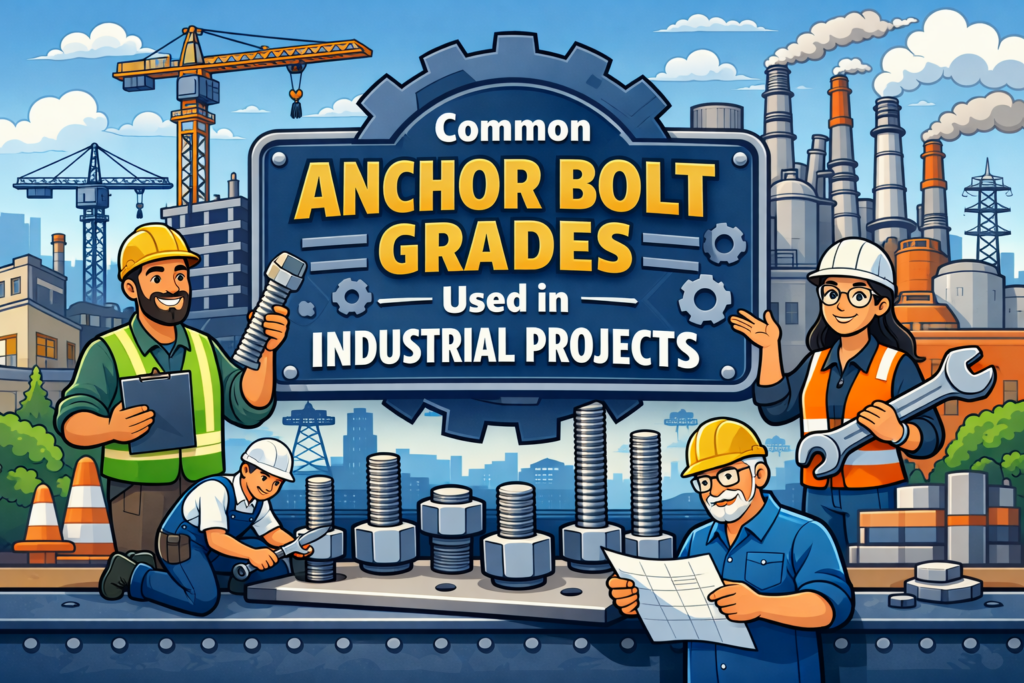
- Grade 8.8 – Industry Standard for Structural Applications
Grade 8.8 anchor bolts are the most widely used in industrial projects in India.
Typical applications:
Steel columns and base plates
- Industrial sheds and factories
- PEB structures
- STP and infrastructure projects
Why Grade 8.8 is preferred:
- Good balance of strength and ductility
- Compatible with RCC grades M25 to M35
- Reliable performance under static and moderate dynamic loads
Mechanical properties (approx.):
- Ultimate tensile strength: 800 MPa
- Yield strength: 640 MPa
👉 As per good engineering practice, Grade 8.8 is structurally adequate for most industrial anchoring requirements.
2. Grade 10.9 – For Heavy Loads and Dynamic Conditions
Grade 10.9 anchor bolts are used where higher stresses or dynamic effects are expected.
Typical applications:
- Heavy machinery foundations
- Vibrating or rotating equipment
- Impact and high-load zones
Key considerations:
- Higher strength than Grade 8.8
- Requires strict torque control
- Installation quality is critical
- Higher cost compared to Grade 8.8
👉 Recommended only where design forces justify the higher grade.
3. Grades 5.8 / 6.8 – Limited Structural Use
Lower-grade anchor bolts are generally restricted to non-critical applications.
Typical applications:
- Handrails and guardrails
- Secondary steel members
- Pipe supports and bracket
Not recommended for primary load-bearing industrial structures.
Chemical vs Cast-in Anchor Bolts (Industrial Practice)
Cast-in Anchor Bolts
- Preferred for new construction
- Better load transfer and reliability
- Lower dependence on workmanship after concreting
Chemical / Post-Installed Anchors
- Used for retrofitting and strengthening
- Require strict control of:
- Hole cleaning
- Resin quality
- Installation procedure
Both systems must satisfy load, edge distance, spacing, and concrete strength requirements.
Typical Recommendation for Industrial Projects
| Application | Recommended Grade |
| Steel columns & base plates | Grade 8.8 |
| PEB structures | Grade 8.8 |
| Heavy machinery & vibration | Grade 10.9 |
| Secondary / non-structural | Grade 5.8 / 6.8 |
Professional Engineering Recommendation
For most industrial projects in India, anchor bolts of minimum Grade 8.8 are structurally adequate when designed and installed as per IS code principles. Grade 10.9 anchor bolts should be adopted only where higher loads, vibration, or dynamic effects are involved.
Key Takeaway
The performance of anchor bolts is governed not only by steel grade, but equally by:
- Embedment depth
- Edge distance and spacing
- Concrete grade
- Installation workmanship
A well-designed Grade 8.8 anchor bolt system, properly detailed and executed, will outperform a poorly installed higher-grade bolt.
Need Help?
If you are working on industrial sheds, factories, STP structures, or machinery foundations, proper anchor bolt design can significantly improve safety and service life.
Explore more: If planning to build your dream home?
Check out Eternal Foundations—a helpful guide to building a strong, safe home that lasts for generations.📩 For a free e-book, email me at kapil.chawla@tesproconsultants.com