

Soil investigation is the foundation of safe and economical structural design. Therefore, the importance of soil testing becomes critical at the very beginning of any project. While soil testing is physically carried out by geotechnical agencies, the structural Engineer plays a critical and controlling role throughout the process. Moreover, treating soil testing as a mere laboratory exercise without structural input often leads to unsafe assumptions, over-design, or costly revisions.
This blog outlines the true purview and responsibilities of a structural Engineer during soil testing for construction.
Deciding the Scope of Soil Investigation
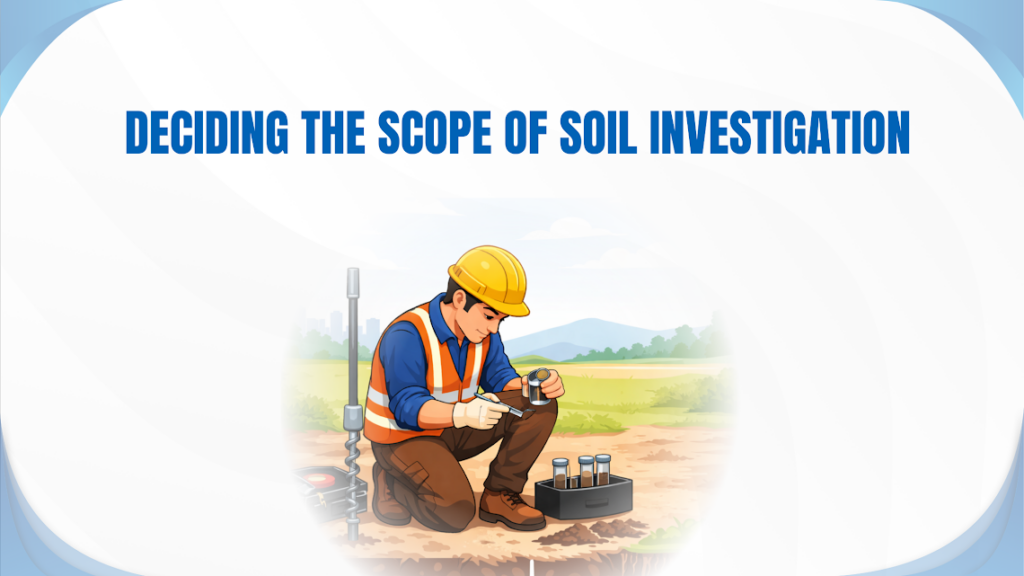
A structural Engineer defines what level of soil investigation is required. Therefore, this decision is based on:
- Type of structure (residential, industrial, high-rise, PEB, water tanks, etc.)
- Proposed loading intensity
- Foundation system under consideration
- Local soil profile and seismic zone
Additionally, the engineer decides:
- Number of boreholes
- Depth of investigation (as per IS 1892 & IS 6403)
- Types of soil testing such as SPT, DCPT, plate load test, triaxial, consolidation, etc.
Key Point: Hence, for construction soil testing is not “standard for all projects”; it is structure-specific.
Selection of Borehole Locations
The Structural Engineer reviews and approves borehole locations. Consequently, this is done considering:
- Column grid and load concentration zones
- Shear wall or heavy machine foundation areas
- Basement footprints (if any)
- Future expansion possibilities
However, random or contractor-decided borehole locations can result in misleading soil parameters.
Monitoring Field Testing Procedures
Though testing is executed by a geotechnical agency, the structural Engineer ensures quality control. For example:
- Bore depth achieved as per requirement
- SPT conducted correctly (energy correction awareness)
- Groundwater table properly recorded
- Undisturbed samples taken where required
Moreover, structural engineers often identify site realities that may not be evident in lab reports.
Interpretation of Soil Test Results
The most critical role of a structural Engineer lies in interpreting soil test results, not just accepting reports.
Therefore, the engineer evaluates:
- Safe Bearing Capacity (SBC) relevance to actual loading
- Allowable vs ultimate bearing capacity
- Settlement criteria (total & differential)
- Liquefaction potential (especially in seismic zones)
- Soil aggressiveness affecting concrete durability
Hence, soil parameters must be validated against structural loading, not used blindly.
Foundation Type Recommendation
Based on soil data, the structural Engineer finalizes foundation design decisions. Accordingly, this may include:
- Isolated footing / combined footing
- Raft foundation
- Pile foundation (end bearing or friction)
- Mat foundation with ground improvement
- Special foundations (under-reamed piles, machine foundations)
This decision, therefore, balances safety, serviceability, economy, and constructability.
Coordination with Geotechnical Consultant
A structural Engineer coordinates with the geotechnical consultant. As a result, this helps to:
- Seek clarifications on anomalies in soil data
- Request additional tests if results are inconsistent
- Align recommendations with structural design philosophy
Thus, engineering judgment bridges the gap between geotechnical theory and structural reality.
Compliance with Indian Standards
Furthermore, structural engineers ensure soil testing aligns with Indian Standards, highlighting the importance of soil testing for regulatory compliance:
- IS 1892 – Subsurface Investigation
- IS 6403 – Bearing Capacity
- IS 8009 (Part 1 & 2) – Foundations
- IS 2911 – Pile foundations
- IS 456 – Durability considerations
- IS 1893 – Seismic considerations
Otherwise, non-compliance may lead to design rejection or legal liability.
Risk Management and Design Responsibility
Ultimately, the structural Engineer owns the foundation design, not the soil testing agency. Therefore:
- Unrealistic SBC values must be questioned
- Over-conservative assumptions should be avoided without justification
- Assumptions and limitations must be recorded clearly
- Client interests must be protected while maintaining public safety
Conclusion
In conclusion, soil testing for construction is not an isolated activity—it is an integral part of structural engineering judgment. A competent structural Engineer ensures that soil investigation is adequate, relevant, interpreted correctly, and applied responsibly.
Otherwise, ignoring structural involvement in soil testing can lead to unsafe foundations, excessive construction cost, design revisions, and structural distress during service life.
Good foundations start with good soil engineering—and good soil engineering starts with the Structural Engineer.
Explore more: If planning to build your dream home?
Check out Eternal Foundations—a helpful guide to building a strong, safe home that lasts for generations.📩 For a free e-book, email me at kapil.chawla@tesproconsultants.com