
Can I Continue Construction as per Old Structural Drawings Without NDT Testing?
This is a very common question I receive as a structural engineer:
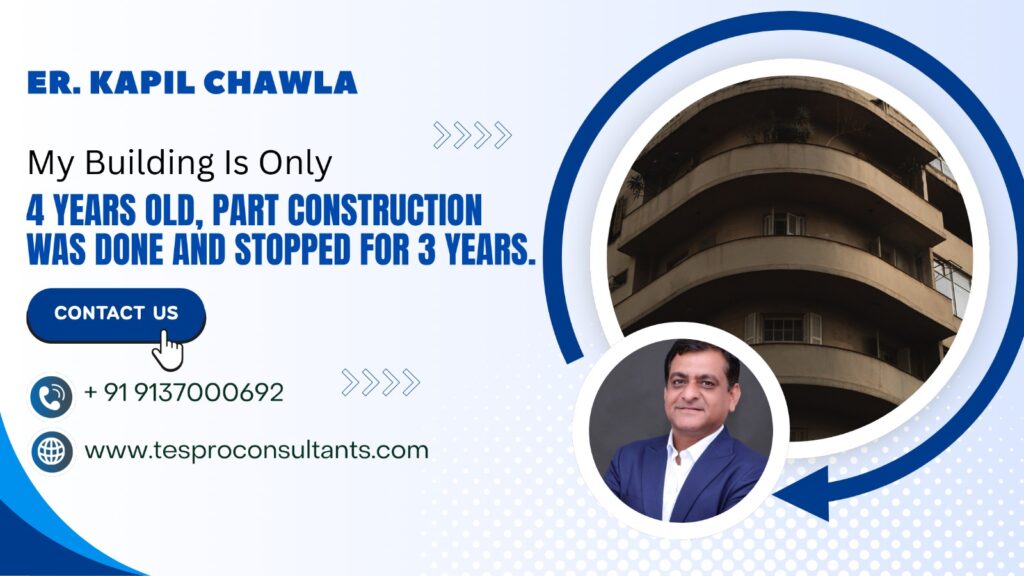
“My building is hardly 4 years old. Only part construction was done, and work was stopped for the last 3 years. Now I want to restart construction exactly as per the old structural drawings. Is NDT testing really required?”
At first glance, the answer appears obvious to many clients —
“The building is young; nothing should be wrong.”
But structural safety does not work on assumptions. Let us understand this with a simple real-life example.
The Medical Analogy: A Young, Fit Boy
Imagine a 25-year-old boy.
- He looks healthy
- He is fit
- He has no visible illness
- He exercises regularly
Now, without conducting any medical tests — no blood tests, no ECG, no BP check — can even the most experienced physician give a 100% guarantee that everything inside his body is perfectly normal?
The answer is NO.
Why?
Because:
- Many health issues are not visible externally
- Problems may exist internally without symptoms
- Only diagnostic tests can confirm actual health
Now Replace the Boy with Your Building
Your building may be:
- Only 4 years old
- Visually looking sound
- Constructed as per approved drawings
- Left unused and exposed for 3 years
But internally, several things may have changed.
Just like the human body, a building also “ages” when left unattended, and this could affect its structural safety.
What Happens to a Partially Constructed Building Left Idle?
During the 3 years of construction stoppage, the structure may have experienced:
- Carbonation of concrete
- Moisture ingress
- Corrosion initiation in reinforcement
- Honeycombing is becoming active
- Shrinkage cracks widening
- Variation in concrete strength due to improper curing
- Environmental exposure (rain, heat, pollution)
Most of these issues cannot be judged by the naked eye. Therefore, a structural assessment is needed to ensure the building’s integrity.
Why Old Structural Drawings Alone Are Not Enough
Structural drawings are based on assumed material strengths:
- Concrete grade
- Steel strength
- Bond between steel and concrete
But after years of exposure and stoppage:
- Actual concrete strength may differ
- Steel corrosion may have reduced capacity
- Structural members may not behave as originally designed
So, continuing the construction, which is already part construction blindly as per the old drawings, is equivalent to:
Taking medicines without a diagnosis.
What Is NDT Testing and Why Is It Required?
Non-Destructive Testing (NDT) helps assess the actual health of the structure without damaging it.
Common tests include:
- Rebound Hammer Test (surface strength)
- Ultrasonic Pulse Velocity (internal quality)
- Half-cell potential (corrosion probability)
- Cover meter test (reinforcement cover)
These tests help answer critical questions:
- Is the concrete still strong enough?
- Has corrosion started?
- Is the existing structure safe to take future loads?
Concrete strength testing and corrosion in reinforced concrete can be detected through these tests.
Real-World Example from Practice
I have personally seen cases where:
- Buildings looked perfectly fine
- But NDT revealed low concrete strength
- Reinforcement corrosion had already started
- Structural strengthening became necessary before proceeding further
Had part construction continued without testing, the risk of:
- Excessive deflection
- Cracking
- Long-term durability failure
- Even structural distress
would have increased significantly. A structural health monitoring process could have prevented these issues.
Final Verdict: Is NDT Testing Really Required?
Yes. Absolutely.
Not because:
- The building is old
But because:
- The building has remained exposed and incomplete
- Actual material health is unknown
- Structural safety must be verified, not assumed
Just like a doctor relies on tests before certifying health,
A structural engineer relies on NDT results before certifying safety.
Advice to Building Owners
Before restarting part construction:
- Conduct NDT testing
- Get a structural assessment report
- Review old drawings based on test results
- Proceed only after structural confirmation
This small step today can:
- Save huge repair costs tomorrow
- Ensure the safety of occupants
- Increase the life of the building
- Give peace of mind
Remember:
👉 A building may look healthy, but only tests can confirm its fitness. Don’t skip structural safety assessment or concrete strength testing for your building.
Explore more: If planning to build your dream home?
Check out Eternal Foundations—a helpful guide to building a strong, safe home that lasts for generations.📩 For a free e-book, email me at kapil.chawla@tesproconsultants.com